
Data Centre Sustainability Metrics Explained
10 September 2026
What are PUE, WUE, ERF, REF, CER and CUE in Data Centres?
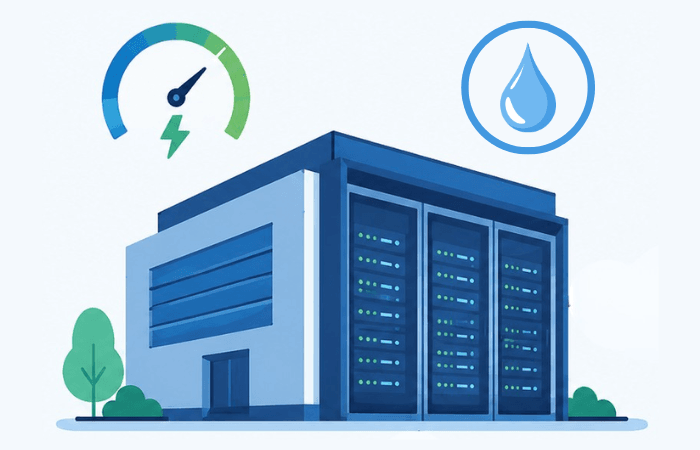
As data centres race to grow capacity to keep pace with demand, energy, water and emissions performances are moving to the top of the list of priorities.
The data centre metrics that are commonly used to assess these areas are:
- Power Usage Effectiveness (PUE) – Energy consumption tracking
- Water Usage Effectiveness (WUE) – Water intensity
- Renewable Energy Factor (REF) – Measuring green energy usage
- Energy Reuse Factor (ERF) – Quantifying waste heat reuse
- Cooling Efficiency Ratio (CER) – Cooling system performance
- Carbon Usage Effectiveness (CUE) – Tracking CO₂ emissions
Direct Air Capture (DAC) can support in these areas when it is integrated with the data centre’s waste heat and cooling systems as certain solid sorbent DAC systems can use low-temperature waste heat, recover water and provide data centre cooling.

Power Usage Effectiveness (PUE)
PUE measures how much of a data centre’s total energy is used by its IT equipment. Therefore, PUE is a metric showing energy efficiency in a data centre.
It is calculated as follows:
PUE = Total data centre energy use ÷ IT equipment energy use
Data centre energy includes the electricity supplied to:
- Servers (IT energy)
- Data storage (IT energy)
- Network equipment (IT energy)
- Cooling equipment (supporting load)
- Uninterruptible power supplies (supporting load)
- Lighting (supporting load)
PUE Calculation Example
Assume that a data centre uses 75 MW of electrical power. Of this, 50 MW is supplied to IT equipment.
PUE = 75 MW ÷ 50 MW
PUE = 1.50
A PUE of 1.00 would mean that all facility energy was being supplied directly to IT equipment. In practice, some supporting energy will always be required.
Therefore, a lower PUE normally indicates that less energy is being used for cooling, power conversion and other non-IT loads.
Cooling can represent a large part of the non-IT load because heat generated by servers must be removed continuously.
However, PUE does not show the carbon intensity of the electricity supply and waste heat reuse is also not considered in the standard PUE metric. PUE should therefore be assessed alongside:
- Carbon Usage Effectiveness (CUE)
- Energy Reuse Effectiveness (ERE)
- Cooling Efficiency Ratio (CER)
Water Usage Effectiveness (WUE)
WUE measures the amount of water used by a data centre in relation to the energy consumed by its IT equipment. Therefore, WUE is a metric showing how efficiently a data centre uses water.
It is calculated as follows:
WUE = Annual data centre water use in litres ÷ Annual IT energy use in kWh
WUE Calculation Example
Assume that a data centre consumes 10 million litres of water per year and that its IT equipment uses 8 million kWh per year.
WUE = 10,000,000 litres ÷ 8,000,000 kWh
WUE = 1.25 L/kWh
A lower WUE indicates that less water is being used relative to the data centre’s IT energy demand.
Where is water used in data centres? Water may be used for:
- Cooling towers
- Evaporative cooling
- Humidification
- Cleaning and general building use
PUE and WUE should be assessed together. A design change that reduces water use could increase electricity use. Alternatively, evaporative cooling could improve PUE while increasing WUE.
Closed circuit liquid cooling systems for data centres use far less water than evaporative cooling set-ups.
Energy Reuse Factor (ERF)
ERF measures the proportion of a data centre’s total energy consumption that is subsequently reused.
It is calculated as follows:
ERF = Reused energy ÷ Total data centre energy consumption
ERF ranges from 0 to 1. An ERF of 0 means that none of the data centre’s energy is reused, while a higher ERF means that a larger share is being put to another useful purpose.
ERF Calculation Example
Assume that a data centre consumes 80 GWh of energy per year. Heat equivalent to 16 GWh per year is recovered and supplied to another process.
ERF = 16 GWh ÷ 80 GWh
ERF = 0.20
Therefore:
ERF = 20%
This means that an amount of useful energy equivalent to 20% of the data centre’s annual energy consumption is being reused.
How can data centre energy be reused?
Almost all electricity consumed by IT equipment eventually leaves the equipment as heat, but some of it can be recovered and supplied to another process.
Potential uses include:
- Direct Air Capture
- District or building heating
- Industrial processes
For EU data-centre reporting, reused energy is measured where it crosses the data centre boundary. This is important to note as heat simply circulated internally within the data centre is not treated in the same way as useful heat supplied to an external process.
Can Direct Air Capture increase ERF? Yes, there is a strong use case for DAC + waste heat. Read in more detail how DAC can reuse data centre waste heat: EU Energy Efficiency Directive: Data Centre Waste Heat Powering DAC
Renewable Energy Factor (REF)
REF measures the proportion of a data centre’s total energy consumption that is supplied from renewable energy.
It is calculated as follows:
REF = Renewable energy consumption ÷ Total energy consumption
REF is expressed as a ratio between 0 and 1, although it can also be presented as a percentage. A higher REF indicates that a greater proportion of the data centre’s energy demand is being met using renewable energy.
REF Calculation Example
Assume that a data centre consumes 80 GWh of energy per year and 60 GWh is supplied from qualifying renewable sources.
REF = 60 GWh ÷ 80 GWh
REF = 0.75
Therefore:
REF = 75%
This means that 75% of the data centre’s total energy consumption is supplied from renewable energy.
Cooling Efficiency Ratio (CER)
CER measures how efficiently a data centre’s cooling system removes heat.
It is calculated as follows:
CER = Heat removed from the data centre ÷ Energy consumed by the cooling system
Both values are normally measured over the same reporting period. A higher CER generally indicates that more heat is being removed for each unit of electricity consumed by the cooling system.
CER Calculation Example
Assume that cooling systems remove 30 GWh of heat from a data centre during one year and consume 6 GWh of electricity.
CER = 30 GWh ÷ 6 GWh
CER = 5.0
Therefore, 5 kWh of heat is removed for every 1 kWh of electrical energy consumed by the cooling system.
CER differs from PUE because it focuses specifically on cooling performance whereas PUE looks at the complete data-centre facility.
What affects CER?
Cooling performance can be affected by the cooling technology, outdoor conditions and operating temperatures.
Liquid cooling can also change the way heat is collected from IT equipment. Higher coolant temperatures can improve the potential for useful heat recovery because the temperature difference between the recovered heat and the receiving process can be reduced.
ISO/IEC 30134-7, the ISO standard for data centre key indicators, applies to electrically powered cooling systems and does not cover cooling systems driven by non-electrical energy, such as heat-driven absorption chillers.
Carbon Usage Effectiveness (CUE)
CUE measures the operational CO₂ emissions associated with a data centre relative to the energy consumed by its IT equipment.
It is calculated as follows:
CUE = Total data centre CO₂ emissions ÷ IT equipment energy consumption
CUE is normally expressed as:
kg CO₂/kWh of IT energy
A lower CUE indicates lower operational CO₂ emissions relative to IT energy consumption.
CUE Calculation Example
Assume that a data centre’s IT equipment consumes 50 GWh per year and its associated operational emissions are 15,000 tonnes of CO₂.
First, the units are converted:
15,000 tonnes CO₂ × 1,000 = 15,000,000 kg CO₂
50 GWh × 1,000,000 = 50,000,000 kWh
CUE is then calculated:
CUE = 15,000,000 kg CO₂ ÷ 50,000,000 kWh
CUE = 0.30 kg CO₂/kWh
The data centre therefore produces 0.30 kg of operational CO₂ emissions for each kWh consumed by its IT equipment.
What determines CUE?
Electricity carbon intensity has a direct effect on CUE. Two data centres with the same PUE could have different CUE values if their electricity is supplied from energy systems with different carbon intensities. Additionally, it does not provide a complete life-cycle carbon assessment covering emissions associated with construction or manufacturing IT equipment.
CUE can also be expressed using PUE and the carbon emissions factor of the energy supply:
CUE = PUE × Carbon emissions factor
For example, assume:
PUE = 1.20
Electricity emissions factor = 0.20 kg CO₂/kWh
Then:
CUE = 1.20 × 0.20
CUE = 0.24 kg CO₂/kWh
This relationship shows why energy efficiency and electricity supply both affect operational carbon performance.
How Do REF, ERF, CER and CUE Work Together?
No single metric provides a complete assessment of data-centre resource use. Each metric answers a different question:
| Metric | What It Measures | Preferred Direction |
| PUE | Facility energy relative to IT energy | Lower |
| WUE | Water consumption relative to IT energy | Lower |
| REF | Share of energy supplied from renewable sources | Higher |
| ERF | Share of data centre energy reused | Higher |
| CER | Heat removed per unit of cooling energy | Higher |
| CUE | Operational CO₂ emissions relative to IT energy | Lower |
Changes to one metric can affect another and therefore a data centre needs to be assessed across several metrics rather than focusing on one figure.
How Can Direct Air Capture Affect Data Centre Sustainability Metrics?
Some solid sorbent Direct Air Capture systems (How does Direct Air Capture Work?) can be regenerated at temperatures below 100°C, such as NEG8 Carbon’s DAC technology which uses 65°C This creates an opportunity for low temperature heat from data centre cooling systems to be used in the DAC regeneration process.
For more details, see Sustainable Data Centres with Direct Air Capture
Heat can be transferred from server or liquid cooling circuits to the DAC system, where it supports CO₂ capture and regeneration. Cooler water can then be returned to the data centre, reducing the load on chillers, cooling towers or dry coolers. This can lower non-IT electricity demand and improve Energy Reuse Factor (ERF). It can also improve Power Usage Effectiveness (PUE) but the effects are not automatic and differ case by case. The useful export of waste heat can also reduce cooling electricity consumption.
NEG8 Carbon’s DAC process produces water as a by-product which can reduce mains water demand and support improved Water Usage Effectiveness (WUE).
Note that atmospheric CO₂ removal should be reported separately from Carbon Usage Effectiveness (CUE), unless the selected CUE methodology specifically permits its inclusion.
Can DAC provide cooling for a data centre?
DAC is not treated as a replacement for the main data centre cooling system but it supplies supplementary cooling. For more details, see Data Centre Cooling Solutions with Direct Air Capture
EU Data Centre Reporting
REF and ERF have a regulatory role within the EU Commission Delegated Regulation (EU) 2024/1364 sets out sustainability information and KPI methodologies for data centres within its reporting scope. (See: EU Energy Efficiency Directive: Data Centre Waste Heat Powering DAC)
Additionally, ISO/IEC 30134-6:2021 lays out data centre key performance indicators.
As data centre energy demand increases, greater focus is being placed on where the energy comes from and what happens to it after it has been used.
Conclusion
PUE and WUE measure energy and water performance, while REF, ERF, CER and CUE provide additional information on renewable energy, energy reuse, cooling and operational carbon emissions. When considered together, these metrics provide a broad assessment of data-centre operations. Futhermore, waste heat and Direct Air Capture can be assessed as part of the same energy system, especially for data centres seeking to increase energy reuse while reducing operational emissions.
For more:
- Sustainable Data Centres with Direct Air Capture
- AI for Good, Data Centre Growth and the Carbon Removal Link
- Data Centre Cooling Solutions with Direct Air Capture
- The Future of Data Centres: What LCAW Revealed
- The Data Centre Industry has a Problem. Actually, it has Three
- What Waste Heat Reuse Does for Data Centre Approvals
- Green Energy Parks Should Include Direct Air Capture for Clean Growth
- Direct Air Capture Using Waste Heat
- Heat Reuse in Data Centres Beyond District Heating