
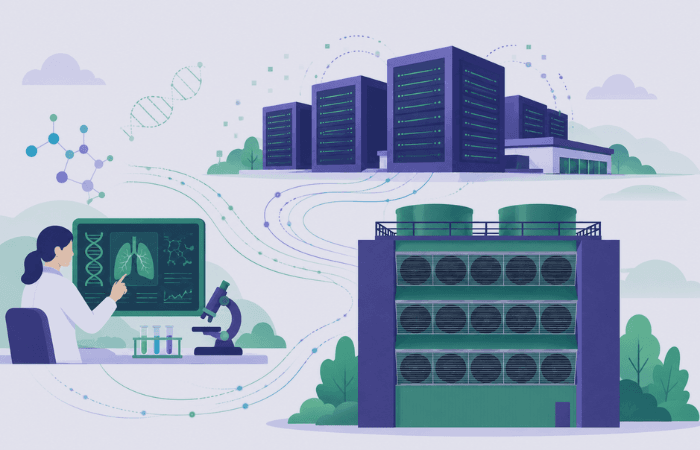
AI for Good, Data Centre Growth and the Carbon Removal Link
22 June 2026
Behind all the incredible things that AI does and the established digital technology that has permeated our lives sits physical infrastructure, by which we mean, data centres.
Going forward, more data centres will be needed to support the burgeoning AI sector but the bottom line is how data centres should be powered, cooled and decarbonised.
As an indication of the urgent challenge ahead, the International Energy Agency (IEA) projects that global data centre electricity consumption will almost double from the 2024 level by 2030.
Although AI can do social and economic good, a responsible AI strategy must include a responsible data centre strategy.
AI Is Already Doing Good
The benefits of AI are already being seen in many applications despite the negative perceptions that AI has gathered around it. We want AI to be used to benefit humanity and improve our lives, but for it to do that, we need to tread wisely in managing its advancement.
Using medicine and pharmaceutical research as an example, AI is currently being used to help researchers find patterns in complex data, support diagnosis, speed up drug discovery and reduce the time spent on early research tasks.
One such example is protein structure prediction. Google DeepMind’s AlphaFold has predicted more than 200 million protein structures, with the database made freely available to researchers. According to Google DeepMind, AlphaFold has been used by more than three million researchers and has helped speed up research into areas such as disease, antimicrobial resistance and heart disease.
Large health-data and genomics projects show the same direction of travel. In Europe, Denmark’s National Genome Centre has built secure national infrastructure to support whole-genome sequencing and personalised medicine. (Lifebit and Danish National Genome Centre)
AI, data and crucial research for good are therefore not separate subjects. They are increasingly linked. If Ireland and Europe want to remain serious locations for medicine, biotechnology and advanced manufacturing, they will need the computing infrastructure to support that work.
Data Centre Industry Growth Needs Carbon Removal Built into a Climate Strategy
Although data centres and AI are potential powerhouses for good, they are big, they use electricity continuously and many need water for cooling. This is the core dilemma. There are options to reduce their impact, such as using renewable power, but no single measure removes every risk.
Decarbonisation of Data Centres
Carbon removal is not a licence to keep using fossil energy. On the contrary, data centres should use all the tools at their disposal first to reduce emissions, for example, high-efficiency cooling, clean power purchase agreements and low-carbon construction materials. And they should avoid drinking water use where recycled or non-potable water is suitable.
However, even with these measures, residual emissions will remain. They may come from backup systems, grid electricity during constrained periods and logistics, to name a few. This is where durable carbon removal must be employed.
AI Companies Buying Carbon Removal
Anthropic joining Frontier is a logical next step for an AI company (What Frontier’s $915 Million Commitment to Carbon Removal Means for Direct Air Capture). In June 2026, the Big Tech-backed Frontier carbon removal coalition added Anthropic and increased its funding by $915 million, bringing total pledges to $1.8 billion. The new funding is expected to support technologies, including Direct Air Capture (DAC), to develop deepTech to decarbonise heavy emitters, like data centres, by creating a demand for carbon credits.
Where DAC Fits with Data Centres and AI Growth
There is also a strong technical link between Direct Air Capture and data centres. Research highlighted by the European Commission found that data centre waste heat, typically in the 30°C to 70°C range, could be used for applications including DAC, water purification, atmospheric water harvesting and cooling through sorption chillers (all of which NEG8 Carbon’s DAC technology can deliver).
The same analysis identified DAC powered by waste heat and thermal water purification as two of the most promising options. Furthermore, DAC has a clear fit for technology companies because it is measurable, engineered and suited to long-term procurement (How DAC Works).
This points to a better model for sustainable AI infrastructure. Instead of treating waste heat as a problem to be rejected into the air, it can be treated as an input. In the end, AI infrastructure should be designed as part of a circular energy, carbon and water system.
Conclusion: AI, Data Centres and Carbon Removal Should be Connected
The growth of AI and the growth of carbon removal can be treated as integrated stories.
↪ AI requires data centres.
↪ Data centres require energy, water and materials.
↪ These create climate and community impacts.
↪ Carbon removal helps mitigate these effects.
AI is already benefiting society by advancing science, medicine and business but the infrastructure behind AI must be built with responsible social and environmental ambition.
For more:
- Sustainable Data Centres with Direct Air Capture
- Data Centre Cooling Solutions with Direct Air Capture
- The Future of Data Centres: What LCAW Revealed
- The Data Centre Industry has a Problem. Actually, it has Three
- What Waste Heat Reuse Does for Data Centre Approvals
- Green Energy Parks Should Include Direct Air Capture for Clean Growth
- Data Centre Sustainability Metrics Explained
- Direct Air Capture Using Waste Heat