
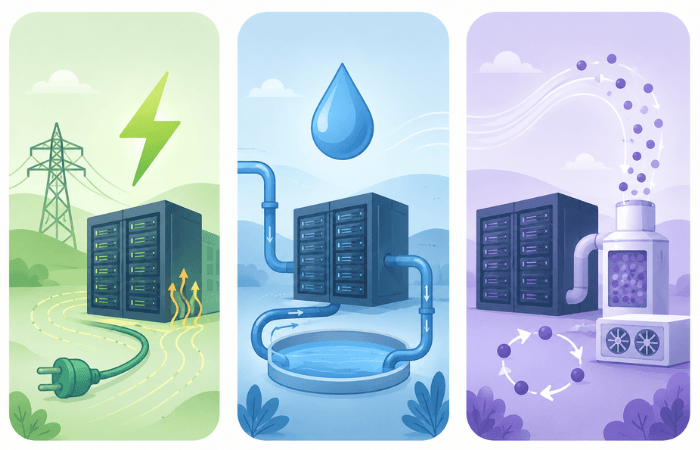
The Data Centre Industry has a Problem. Actually, it has Three
29 June 2026
By Dr David Mulrooney, Head of Business Development at NEG8 Carbon
Spend a day in a room with data centre operators, investors and innovators and one picture quickly forms. The sector has scale, capital and political support, yet three linked constraints now shape its growth path: energy, water and carbon emissions.
Problem 1: Energy and the Expectation to give it Back
Across Europe, AI demand is driving a new wave of data centre investment. The European Commission has now set an aim to at least triple EU data centre capacity, while studies point to sharp increases in electricity demand across major and emerging markets.
Denmark shows the scale of the issue. One Danish analysis estimated that data centres could consume 8.8 TWh by 2030, equal to about 28% of Denmark’s 2020 final electricity use, and in Ireland it is at 22%. Those figures alone explain why policymakers now see data centres as part of national energy planning rather than as isolated industrial loads.
Regulation has started to catch up. EU rules now require larger data centres to report energy and sustainability indicators, including energy reuse. Germany has gone further, and as from 1 July 2026, new data centres must reuse a minimum share of waste heat, with the requirement rising over time. (Germany’s Energy Efficiency Act requires new data centres from July 2026 to meet a 10% energy reuse factor, rising to 15% in 2027 and 20% in 2028.)
Operators can already see where this is heading. Communities, utilities and regulators expect data centres to contribute energy back into heating networks, grids and local systems and data centres can no longer get away with being passive consumers of resources. Take this example in Amsterdam for instance, where waste heat from a data centre can support a district heating network.
Problem 2: Water is a Silent Planning Crisis
Water issues are now filling the headlines, as they become a direct constraint on data centre build-out in a growing number of markets. Traditional data centre cooling systems consume large volumes of water and local communities are now pushing back and questioning whether new facilities should compete with homes, agriculture and industry for the same resource.
This concern is starting to show up in permit delays and sometimes outright refusal on the back of community opposition. Furthermore, water risk has also become an investor issue, as new facilities move into areas already exposed to scarcity.
If you were to create a global map overlaying water stress data with existing data centre locations, the overlap would be stark and concerning. And those in the data centre industry plus the investors know all about it. They also know that technology solutions to reduce or eliminate freshwater dependency, or that produce water as a by-product, are attracting serious commercial attention. NEG8 Carbon’s Direct Air Capture technology produces water as a by-product of hte DAC process.
Problem 3: Carbon and the Accountability Gap
Data centre operators have made progress on electricity procurement. For example, Google has matched 100% of its annual electricity consumption with renewable energy since 2017. Meanwhile, Microsoft has used power purchase agreements to contract renewable electricity for its data centres, campuses and buildings.
Even so, energy procurement alone does not address every carbon source. Construction materials, mechanical equipment, supply chains and residual operational emissions still create a difficult emissions challenge.
The market has started to ask a harder question: what happens to the carbon in the air above a data centre? Microsoft’s long-term carbon removal offtake agreement with Climeworks shows how major digital infrastructure companies are starting to use engineered carbon removal alongside renewable power. Another Microsoft initiative is the DACinDC project where Microsoft is piloting using data centre waste heat to power Direct Air Capture to decarbonise a data centre. This goes beyond purchasing carbon offsets and marks the next frontier for data centre operators serious about their net-zero commitments.
The Waste Heat Solution
These three constraints connect through one common resource: waste heat. Data centre waste heat is abundant, continuous, and at most sites, doing nothing. It is a stranded asset. Better systems can feed that heat into water production, cooling, carbon capture or district heating. (See: Sustainable Data Centres with Direct Air Capture)
Conclusion
The data centre sector understands this direction of travel and the race now is for technologies that can do it at the scale, reliability and cost that operators require. And notably, that can navigate the procurement conservatism of an industry that “wants innovation as long as it’s been around for twenty years” as was so succinctly stated at the London Climate Action Week.
This tension is exactly what NEG8 Carbon’s Direct Air Capture technology is built to resolve.
For more:
- Sustainable Data Centres with Direct Air Capture
- AI for Good, Data Centre Growth and the Carbon Removal Link
- Data Centre Cooling Solutions with Direct Air Capture
- The Future of Data Centres: What LCAW Revealed
- What Waste Heat Reuse Does for Data Centre Approvals
- Green Energy Parks Should Include Direct Air Capture for Clean Growth
- Data Centre Sustainability Metrics Explained
- Direct Air Capture Using Waste Heat
- Heat Reuse in Data Centres Beyond District Heating