Carbon credits explained
Carbon credit regulations make the polluters pay for their emissions and establishing a carbon credit market makes climate tech more bankable and thus able to scale.


Carbon credit regulations make the polluters pay for their emissions and establishing a carbon credit market makes climate tech more bankable and thus able to scale.
A carbon credit is a tradable unit representing one metric tonne of CO₂ equivalent (tCO₂e) that has been:
Credits are issued under recognised methodologies after they have been quantified and verified. Once a buyer uses a credit against its emissions, the credit is normally retired in a registry so it cannot be used again.
On a positive note, carbon pricing continues to expand. In 2026, the World Bank reported that direct carbon pricing covered nearly 30% of global greenhouse gas emissions. [World Bank Group]
These two terms are often used interchangeably but they have slightly different meanings. They both represent one metric tonnes of carbon dioxide equivalent (tCO₂e) but they differ in how they are generated and in the markets in which they trade.
A carbon credit is the actual tradable unit, normally representing 1 tCO₂e.
An offset describes how that credit is used. When an organisation purchases and retires a carbon credit to compensate for 1 tonne of its own emissions, that credit has effectively been used as an offset.
There is also an important distinction between reduction or avoidance credits and removal credits. Avoidance credits prevent emissions from occurring, while carbon dioxide removal (CDR) credits physically remove CO₂ already present in the atmosphere.
For net-zero strategies, durable carbon removal is more valuable because residual emissions eventually need to be removed which merely reducing emissions doesn’t achieve.
Carbon Credits Compated to Carbon Offsets
| Feature | Carbon Credit | Carbon Offset |
| Primary Market | Compliance Market (Cap-and-Trade) | Voluntary Market (VCM) |
| Regulated By | Governments and regional authorities | Independent third-party certification bodies |
| Mechanism | An allowance or permit to emit one tonne of CO₂ | A certificate proving one tonne of CO₂ was reduced or removed |
| Target Audience | Heavy industries legally required to cap emissions | Companies and individuals meeting climate targets voluntarily |
| Origin | Allocated or auctioned by a regulatory cap-and-trade programme | Environmental projects, such as reforestation or methane capture |
Carbon credit markets put a price on greenhouse gas emissions, with each credit typically representing one tonne of CO₂ reduced, avoided, or removed. There are two main types: compliance markets, where companies must meet regulatory emissions limits, and voluntary markets, where organisations buy credits to address residual emissions. Credits are generated by verified projects and then traded and retired to prevent them being claimed more than once.
The Voluntary Carbon Market (VCM) allows businesses and individuals to purchase credits without being legally required to do so.
Credits may originate from forestry, methane capture, renewable energy, biochar, enhanced weathering, Direct Air Capture and other projects, and buyers typically buy credits to support climate targets or compensate for emissions.
Prices are negotiated between buyers and suppliers and can vary considerably based on quality, removal method, permanence and MRV. Higher-integrity credits increasingly command higher prices, particularly carbon removal credits and MSCI reported that higher-quality removal categories continued to attract stronger market value during 2025. [MSCI]
A compliance market exists because governments or regulators require certain organisations to manage their emissions.
Examples include:
EU Emissions Trading System (EU ETS): Companies surrender EU Allowances for regulated emissions. EUAs are allowances rather than conventional project-based carbon credits.
California Cap-and-Invest: Regulated companies use allowances but can also use approved offset credits for a limited proportion of their obligations.
Australia’s Safeguard Mechanism: Large industrial facilities can purchase and surrender Australian Carbon Credit Units (ACCUs). Each ACCU represents 1 tonne of emissions avoided or sequestered.
Japan’s GX-ETS: From FY2026, Japan’s Green Transformation Emissions Trading Scheme requires large emitters with annual direct CO₂ emissions of at least 100,000 tonnes to participate with emissions targets, third-party verification and compliance obligations.
CORSIA: International aviation operators can use approved emissions units to meet offsetting obligations under ICAO’s Carbon Offsetting and Reduction Scheme for International Aviation.
Compliance markets generally have stricter eligibility rules because credits or allowances are being used to meet legal obligations.
MRV is the system used to demonstrate that a carbon credit represents a genuine climate benefit.
Credits are then recorded in a registry and tracked. Good MRV also addresses additionality, permanence, leakage and double counting. These requirements are central to the ICVCM Core Carbon Principles (For details on the 10 principles, read The Integrity Council for the Voluntary Carbon Market’s The Core Carbon Principles).
There is no single carbon-credit price but you can get an idea of the prices by following various sites, including:
Conventional voluntary credits currently trade at around US$5–10/tCO₂e, although quality credits can cost considerably more.
On the other hand, durable CDR commands a large premium because permanent removal is harder and more expensive to deliver. Publicly disclosed durable CDR purchases averaged approximately US$320/t in 2024. [CDR.fyi 2024 Year in Review]
Breakeven estimates show the differences between technologies:
| CDR Method | Approx. Supplier Breakeven |
| Biochar | ~US$143/t | ~€124/t |
| Enhanced weathering | ~US$272/t | ~€236/t |
| Mineralisation | ~US$316/t | ~€274/t |
| DACCS | ~US$670/t | ~€581/t |
These figures are market survey estimates rather than fixed market prices. [CDR.fyi: Durable CDR Pricing Gap: What the Latest Survey Reveals & Bridging the Gap: Durable CDR Market Pricing Survey PDF]
Latest 2026 research indicates that durable CDR probably won’t reach a broad market price below US$100/t by 2030. [CDR.fyi: Pricing, Attributes, and Blockers: Durable CDR Market Dynamics Through 2030]
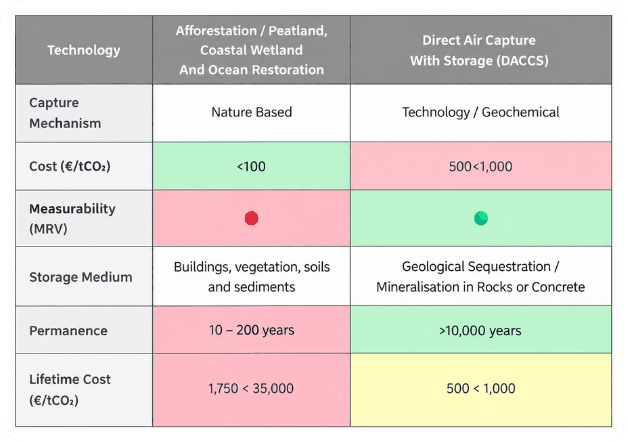
There is no single best carbon dioxide removal CDR technology, however, when carbon credit quality is the main criterion, technologies offering measurable removal and durable storage lasting hundreds or thousands of years are preferred.
Direct Air Capture with Carbon Storage (DACCS), BioCCS, mineralisation and high-quality biochar are more durable than biological storage such as forests or soils. These nature-based removals are useful, but they have higher reversal risks from fire, disease, harvesting and land-use change.
With the EU’s Carbon Removals and Carbon Farming Certification framework, the EU Commission established permanent removal certification methodologies for DACCS, BioCCS and biochar carbon removal, concluding that these technologies had sufficient scientific knowledge and technical maturity for robust certification.
Direct Air Capture with Carbon Storage is one of the strongest approaches for high-integrity removal credits. CO₂ is physically captured from ambient air, measured and then permanently stored, usually in geological formations. This gives a clear link between a tonne captured and a tonne stored.
Note that lifecycle energy use and associated emissions need to be deducted to determine the net CO₂ removal.
Its main disadvantage is cost, however, its strong MRV makes DACCS particularly attractive for premium carbon removal credits.
Carbon credits can channel finance towards verified emissions reductions and carbon removal. Additionally, they are a strong mechanism in the fight against climate change as they force heavy emitters to account for their pollution.
For more: