
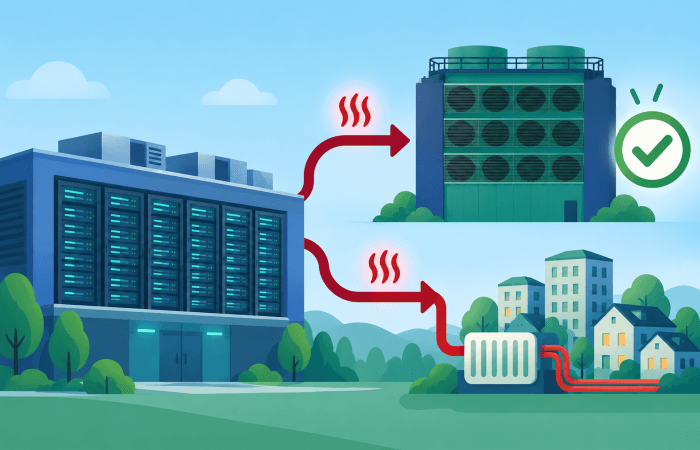
Heat Reuse in Data Centres Beyond District Heating
19 October 2026
Data centre heat reuse is a major factor in improving energy efficiency and reducing the environmental impact of data centres. While district heating has traditionally been the main approach to beneficially reusing heat, Direct Air Capture (DAC) offers another stand-out option.
In this approach, heat from data centres can be reused to power the carbon capture process of DAC. Solid sorbent DAC technologies like NEG8 Carbon’s remove CO₂ from the atmosphere while also providing complementary data centre cooling and producing water as a by-product. Furthermore, the EU Energy Efficiency Directive is mandating the use of heat recovery from data centres to put waste heat to productive use.
Data Centre Waste Heat: An Untapped Energy Resource
Data centres consume substantial amounts of electricity to power servers, networking equipment and cooling systems. Much of this energy eventually becomes heat, which has to be removed to maintain operating temperatures.
Despite the growth in data centre development, much of the heat produced by data centres remains unused. The European Commission’s September 2026 report on data centre energy efficiency found that only about 1.8% of the heat generated by reporting EU data centres was being reused. Just 67 facilities reported some form of waste heat reuse during the first reporting period.
Consequently, recovering this energy presents an opportunity to improve resource efficiency and reduce the environmental impact of data centre operations, and the European Union has recognised the potential of waste heat recovery through its revised Energy Efficiency Directive (EU) 2023/1791.
Importantly, this legislation does not limit heat reuse to district heating. This leaves scope for alternative technologies, including DAC, provided technical and economic feasibility can be demonstrated. Compliance would therefore depend on the specific project and its assessment.
Direct Air Capture as an Alternative to District Heating for Data Centre Waste Heat
District heating uses recovered heat from data centres to warm nearby buildings and supply hot water. Although effective where suitable infrastructure exists, it depends on proximity to heat networks, local demand and seasonal heating requirements.
For data centres located away from residential areas or established district heating systems, these constraints limit heat recovery opportunities.
On the other hand, Direct Air Capture offers an alternative by using recovered heat in an industrial process rather than supplying it to buildings. Unlike space heating, DAC can potentially provide year-round demand for thermal energy.
A 2025 study published in Energy & Environmental Science identified DAC and thermal water purification as promising uses for data centre waste heat, highlighting their potential to reduce emissions and generate valuable outputs.
How Direct Air Capture Uses Data Centre Waste Heat
Depending on the DAC technology, the regeneration stage of the sorbent (material that captures the CO2 molecules) requires thermal energy. Certain solid sorbent DAC systems (like NEG8 Carbon’s DAC) operate at temperatures of around 80-130°C, making them candidates for integration with waste heat sources.
Data centre heat can be transferred to the DAC system through a heat exchanger. As a result, recovered thermal energy replaces the heat that would otherwise need to be supplied specifically for DAC operation which reduces the process’s energy demand.
Research published in Carbon Capture Science & Technology in June 2026 examined the integration of DAC with data centre operations, demonstrating the potential for waste heat to support CO₂ capture while reducing water consumption.
Improving Data Centre Energy Efficiency and Sustainability Through Carbon Capture
Integrating Direct Air Capture with data centre infrastructure combines several environmental benefits within one system.
Heat that would otherwise be rejected can support CO₂ capture, while the transfer of thermal energy to the DAC process can provide complementary cooling. Where water recovery is included, atmospheric moisture can also be collected for reuse.
Furthermore, the captured CO₂ can be permanently stored to deliver carbon removal and carbon credits, or used as a feedstock for products such as eFuels. Where CO₂ is utilised rather than stored, the climate benefit depends on its source, the production process and subsequent emissions.
This approach supports the EU’s objectives for energy efficiency and waste heat recovery while offering data centre operators a further option beyond conventional district heating.
Conclusion: The Future of Heat Reuse in Data Centres
The data centre sector is under pressure to find more productive uses for the heat generated by its operations. District heating will remain an important solution where suitable networks and customers are available. However, it should not be viewed as the only option. Direct Air Capture offers an alternative that can turn data centre waste heat into an input for atmospheric carbon removal, with the added potential for complementary cooling and water production. As EU energy efficiency requirements place greater emphasis on heat recovery, integrating DAC with data centres delivers more efficient energy use and contributes to the development of lower carbon digital infrastructure.
For more:
- Sustainable Data Centres with Direct Air Capture
- NEG8 Carbon to Provide Solution to Data Centre Sustainability Challenges
- Data Centre Cooling Solutions with Direct Air Capture
- The Data Centre Industry has a Problem. Actually, it has Three
- What Waste Heat Reuse Does for Data Centre Approvals
- Green Energy Parks Should Include Direct Air Capture for Clean Growth
- Data Centre Sustainability Metrics Explained
- Direct Air Capture Using Waste Heat
Sources:
- IEA, Energy and AI;
European Commission, Report on the Energy Efficiency of Data Centres in the EU (2026) - Chemical Engineering Journal, Solar-Driven Integrated Device for Simultaneous Direct Air Capture and Atmospheric Water Harvesting (2026)
- Carbon Capture Science & Technology, In-depth Direct Air Capture Integration to Achieve Zero-Carbon and Water Data Center (2026)
- EUR-Lex, Directive (EU) 2023/1791, Article 26;
European Commission, Recommendation (EU) 2024/2395;
EUR-Lex, Delegated Regulation (EU) 2024/1364 - ScienceDirect, A Geographic Analysis and Techno-Economic Assessment of Renewable Heat Sources for Low-Temperature Direct Air Capture in Europe (2024)
- Carbon Capture Science & Technology, In-depth Direct Air Capture Integration to Achieve Zero-Carbon and Water Data Center (2026)
- Royal Society of Chemistry, Flipping the Switch: Carbon-Negative and Water-Positive Data Centers Through Waste Heat Utilization (2025)