
EU Energy Efficiency Directive: Turning Data Centre Waste Heat into a Resource
1 September 2026
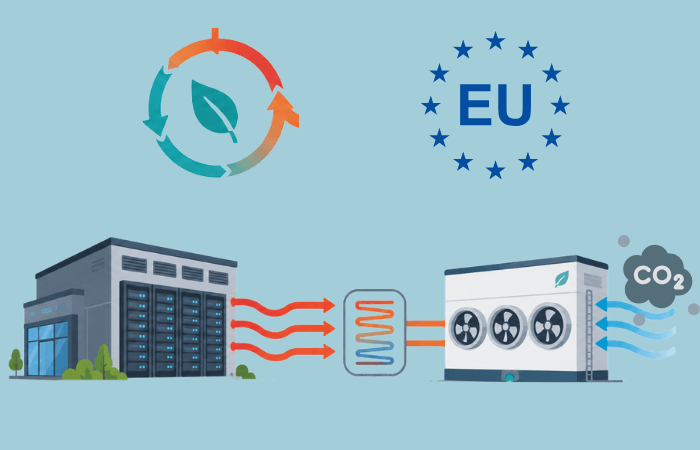
In data centres, almost all the electricity consumed by servers and other IT equipment leaves as waste heat (Uptime Intelligence). Yet much of that heat energy is treated as a cooling problem to keep equipment within its operating temperature range whereas it could be reused as an energy resource.
However, the EU Energy Efficiency Directive (EED) compels data centres to account for this waste heat and the EU is pushing data centre operators to find productive uses for it.
Data Centre Energy Efficiency and Waste Heat Reuse
Waste heat recovery changes the way data centre efficiency is measured. A data centre could have an efficient cooling system but still reject a large amount of useful heat. If that heat is then supplied to another process, a greater proportion of the original electrical energy produces a useful output. This is assessed as the Energy Reuse Factor (ERF) in the EU data centre reporting framework, and it compares reused energy with total data centre energy consumption.
What is the EU Energy Efficiency Directive?
The legislation in question is the Energy Efficiency Directive, Directive (EU) 2023/1791 (EED) and it forms part of the EU’s wider Fit for 55 energy and climate framework. (See: EU Climate Regulations Explained)
At EU level, the Directive sets a binding target to reduce final energy consumption by at least 11.7% by 2030 compared with 2020. The EED covers buildings, industry, public bodies, heating and cooling systems, energy audits and data centres.
Article 12, titled “Data Centres”, establishes the mandatory requirement for operators of data centres with an IT power demand of ≥ 500kW to monitor, report, and publish energy performance data to the central European database annually.
For data centres, the EED introduces two areas of particular importance:
- Monitoring and reporting of energy performance, including waste heat reuse
- Requirements to assess and use waste heat from larger data centres
What Does the EED Require of Data Centres?
Article 26 of Directive (EU) 2023/1791 covers “Heating and Cooling Supply” and contains one of the most important requirements:
EU Member States must ensure that data centres with a total rated energy input greater than 1MW utilise their waste heat or another waste heat recovery application, unless it can be demonstrated that doing so is not technically or economically feasible.
For new data centres above the 1MW threshold, or data centres undergoing substantial refurbishment, an installation level cost-benefit analysis must assess options for waste heat use.
Data Centre Cooling System Design
Article 26 specifically states that solutions should be assessed that allow heat to be removed or captured at a useful temperature while minimising additional energy inputs. This requirement could influence how future data centres are designed.
Data Centre Energy Reporting
Separate requirements apply under Article 12 where data centres with an installed IT power demand of ≥ 500kW must report information on their energy performance.
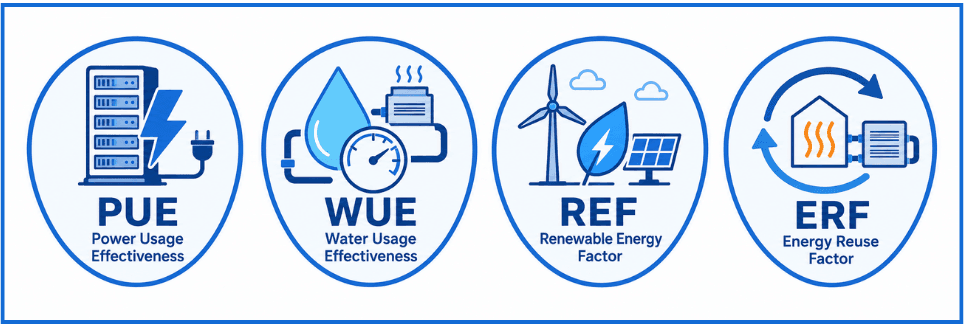
The reporting methodology and sustainability indicators include:
- Power Usage Effectiveness (PUE)
- Water Usage Effectiveness (WUE)
- Renewable Energy Factor (REF)
- Energy Reuse Factor (ERF)
Total Greenhouse Gas (GHG) Emissions: Operators must report Scope 1 (direct emissions, e.g., backup generators) and Scope 2 (indirect emissions from purchased electricity) emissions.
Opportunities for Waste Heat Reuse in Data Centres with Direct Air Capture
District heating is one option that is already being used in a number of locations. However, district heating is highly dependent on location. Other options include industrial processes and water treatment. But a new standout use case for data centre waste heat reuse is emerging with Direct Air Capture (DAC). (See: What is Direct Air Capture?) DAC is particularly suited because a DAC plant can be located beside the continuous heat source.
Certain solid sorbent DAC technologies require heat to release captured CO₂ from the sorbent so that the material can be reused. Some solid sorbent systems can operate using low-temperature heat, as low as 65°C in the case of NEG8 Carbon, which suits the temperature of the cooling liquid/water coming from the data centre, which is usually between 30°C – 70°C (a heat pump can be used if the heat needs to be upgraded).
Rather than producing heat at the DAC plant using electricity or fuel, waste heat from the data centre could supply some or all of the thermal energy required for sorbent regeneration. This can reduce the external energy required per tonne of CO₂ captured and, in turn, reduce the operating cost of DAC.
This is a perfect example of what the EU’s EED is encouraging: energy that has already been produced should be used again where technically and economically possible.
The European Commission has also highlighted research examining DAC powered by data centre waste heat. (European Commission Science for Environment Policy Issue 632) This analysis found DAC to be one of the more promising uses of low-grade data centre heat when both climate impact and economic value were considered.
One of the main problems with waste heat is finding a user close enough to reuse it.
DAC is different to, for example, district heating or industrial use because the capture process can, within certain limits, be located where the energy resource is available. A DAC facility could therefore be planned alongside a data centre rather than requiring the data centre to be built beside an existing heat customer. Continuous data centre operation also works well with a process that can operate for long periods throughout the year.
Co-locating DAC with data centres has other benefits besides waste heat reuse:
- Decarbonisation via carbon capture
- Utilisation of captured CO₂ or revenue from carbon credits
- Data centre cooling
How Much Waste Heat Does a Hyperscale Data Centre Produce?
The quantity of heat available is substantial. The International Energy Agency uses 100MW as a representative capacity for a hyperscale data centre and notes that AI-focused hyperscale facilities can exceed this level.
Almost all electricity consumed by IT equipment is eventually converted into heat, which means that a data centre operating continuously at an electrical load of 100MW can produce approximately 100 MW of thermal energy per hour (876 GWh of heat per year) that ultimately has to be removed.
Not all of this heat can be recovered because the recoverable fraction depends on the cooling system, operating load, temperature and heat exchanger design. Direct-to-chip liquid cooling can produce temperatures of approximately 40°C to 60°C, while current high-temperature AI cooling designs can operate with water entering at up to 45°C and returning from racks at up to 65°C. This is in line with DAC technologies such as NEG8 Carbon’s.
EU Countries and the EED
GERMANY is already ahead of the EU requirement on data centre waste heat. Its Energy Efficiency Act (Energieeffizienzgesetz, EnEfG) entered into force in November 2023 and places specific requirements on new data centres. Under the current law, data centres beginning operation from 1 July 2026 must achieve an Energy Reuse Factor of at least 10%, rising to 15% for facilities starting from July 2027 and 20% from July 2028. Germany is busy revising the EnEfG.
FRANCE has transposed Article 26 into its Energy Code and requires data centres of 1MW or more to recover their waste heat, with an Energy Reuse Factor of at least 0.20, or 20%, from January 2026 unless technical and economic conditions justify an exemption.
FINLAND amended its Energy Efficiency Act through Law 1382/2025, effective from 1 January 2026, requiring data centres above 1MW to reuse waste heat unless they can demonstrate through a cost-benefit analysis that doing so is not technically or economically feasible.
DENMARK has also implemented the requirement. Its 2025 rules require data centres above 1MW to conduct a cost-benefit assessment and reuse waste heat where the assessment shows that recovery is technically and economically feasible.
IRELAND is further behind. An Irish Government transposition update published in April 2026 showed that Article 26 remained part of a “Main EED” Statutory Instrument that was still under development. Parliamentary questions in July 2026 were still seeking clarification on how Article 26 would be transposed, while the proposed Heat (Networks and Miscellaneous Provisions) Bill remained under development.
Conclusion
For DAC developers, co-locating with data centres offers a route to cost reduction, and for data centre operators, the same arrangement provides a productive outlet for waste heat and could increase the site’s Energy Reuse Factor. As both AI computing capacity and carbon removal requirements increase, combining these systems makes use of the same unit of energy twice: first for computing and then for CO₂ capture. Under the Energy Efficiency Directive, that type of energy reuse is becoming part of how Europe’s data centres are expected to operate.
For more:
- Sustainable Data Centres with Direct Air Capture
- What are PUE and WUE in Data Centres?
- Direct Air Capture Using Waste Heat
Sources
- European Commission, Energy Efficiency Directive. European Commission – Energy Efficiency Directive
- EUR-Lex, Directive (EU) 2023/1791 on energy efficiency. EUR-Lex – Directive (EU) 2023/1791
- European Commission, Energy performance of data centres. European Commission – Energy performance of data centres
- European Commission, AI data centre waste heat could be used for water purification and carbon capture, March 2026. European Commission – Data centre waste heat and carbon capture