
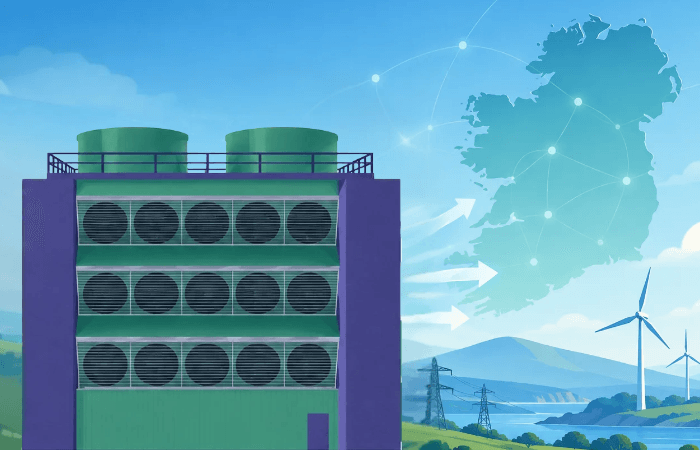
Why Direct Air Capture Should be Critical Infrastructure in Ireland
13 October 2026
Climate Action Needs Critical Infrastructure
As Ireland faces the growing climate crisis, Direct Air Capture (DAC) technology should be recognised as critical infrastructure and afforded the same priority in national planning and development as other essential services.
While electricity networks, transport systems and water infrastructure are recognised for their importance to society and the economy, the infrastructure needed to remove carbon dioxide (CO₂) from the atmosphere deserves similar consideration. With legally binding climate targets approaching, Ireland must not only reduce emissions but also build the systems that remove the CO₂ already in the atmosphere.
According to the Environmental Protection Agency (EPA) [EPA Projections Show Ireland Remains Off Track for 2030 Climate], even with the full implementation of planned policies, Ireland is projected to reduce greenhouse gas emissions by only 25% by 2030, against a national target of 51%. Consequently, carbon removal technologies such as DAC should be viewed as part of Ireland’s long-term national infrastructure requirements.
How Ireland Currently Defines Critical Infrastructure
Ireland has legislation in place that recognises the importance of infrastructure for essential services, public safety and economic stability. The following legal frameworks are particularly relevant:
European Union (Resilience of Critical Entities) Regulations 2024 (S.I. No. 559/2024):
These regulations implement the EU Critical Entities Resilience Directive. They cover 11 sectors, including energy, transport, water, healthcare and digital infrastructure. Their purpose is to ensure that essential services can withstand and recover from disruptions, protecting society and the economy.
Strategic Infrastructure Development (SID) planning framework:
This provides a dedicated planning route for major infrastructure projects of national or regional importance. Eligible developments, such as energy, transport networks, environmental and health infrastructure, pipelines and major public facilities, can apply directly to An Coimisiún Pleanála, if the project qualifies and the Commission decides that it is strategically important.
Climate Action and Low Carbon Development (Amendment) Act 2021:
Although not critical infrastructure legislation, this Act commits Ireland to achieving a climate-neutral economy by 2050. Importantly, it recognises technological solutions for removing greenhouse gases from the atmosphere.
Together, these frameworks demonstrate that Ireland already recognises the need to protect essential services, facilitate nationally critical developments and meet legally binding climate commitments.
However, an important distinction remains: designation as a critical entity primarily creates resilience and security obligations. It does not automatically provide preferential planning treatment. Currently, DAC facilities are not included as a category of strategic infrastructure under the existing planning framework.
Why Direct Air Capture is Critical Infrastructure
Supporting Ireland’s Climate Commitments
Ireland’s climate legislation requires the State to achieve climate neutrality by 2050. Although reducing emissions must remain the priority, carbon removal will also be needed to address residual emissions from sectors that are difficult to decarbonise. [IPCC AR6 WGIII Technical Summary & IPCC AR6 WGIII CDR Factsheet]
DAC provides a technological means of extracting CO₂ directly from ambient air (see: How Direct Air Capture Works). When combined with permanent geological storage, it can deliver measurable carbon removal.
Therefore, developing DAC capacity would help Ireland achieve its climate objectives and reduce dependence on carbon removal infrastructure abroad.
Protecting the Economy and Supporting Industry with DAC
Climate change poses long-term risks to Ireland’s economic stability, infrastructure and public services. Just as energy and water systems support essential national functions, carbon removal infrastructure supports climate neutrality while retaining industrial activity. This is in alignment with the Draghi Report on EU competitiveness.
In addition, captured CO₂ can be used as a feedstock in synthetic fuels and other industrial processes. Although CO₂ utilisation does not constitute permanent carbon removal, it delivers fossil-free carbon supply chains.
Recognising DAC as strategically important infrastructure provides greater certainty for investors and project developers, helping Ireland establish domestic expertise and manufacturing opportunities.
Aligning with European Climate Policy
The European Union has already recognised the role of engineered carbon removals through Regulation (EU) 2024/3012 [European Commission, Carbon Removals and Carbon Farming (CRCF) Regulation], which establishes a voluntary certification framework for permanent carbon removals, carbon farming and carbon storage in products.
Notably, the framework includes Direct Air Carbon Capture and Storage (DACCS), demonstrating that permanent atmospheric carbon removal is now part of European climate policy. DACCS has also been named as one of the permanent CDR approaches in the latest EU ETS review. This will create a guaranteed EU carbon market for DACCS.
Accordingly, Ireland has an opportunity to align its infrastructure planning system with this policy direction while maintaining environmental and regulatory standards.
Conclusion
DAC is a National Infrastructure Priority
Ireland already gives special consideration to infrastructure that supports essential services and national development. Yet the climate crisis presents an equally significant long-term challenge, requiring infrastructure capable of addressing emissions that cannot otherwise be eliminated. Direct Air Capture should therefore be formally recognised as strategically important national infrastructure, with access to the planning priority and policy support afforded to other major infrastructure developments.
Ireland has established legally binding climate objectives. The next step is to ensure that the infrastructure capable of helping achieve them receives the national priority it warrants.
For more:
- NEG8 Carbon to Provide Solution to Data Centre Sustainability Challenges
- NEG8 Carbon’s DAC Technology Wins Premier International Award
- EU Energy Efficiency Directive: Data Centre Waste Heat Powering DAC
- The EU Net Zero Industry Act (NZIA)
Additional Sources:
- Irish Statute Book, European Union (Resilience of Critical Entities) Regulations 2024
- An Coimisiún Pleanála, Strategic Infrastructure Development
- Irish Statute Book, Climate Action and Low Carbon Development (Amendment) Act 2021