
Introduction
eFuels are liquid or gaseous fuels made using electrical energy rather than fossil feedstocks. They are designed to be drop-in fuels that are chemically similar to conventional fossil fuels which means they can be used in existing engines and systems. Green hydrogen (made using renewable energy) and captured CO₂ are combined through fuel synthesis to produce fuels such as eMethanol, eKerosene/eSAF and other synthetic hydrocarbons.
The Role of Direct Air Capture in Making eFuels
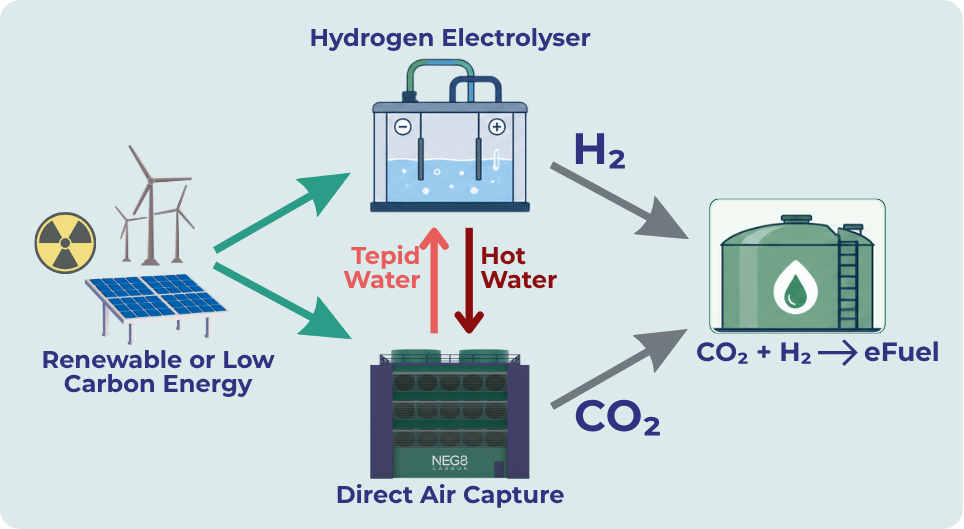
Direct Air Capture (DAC) has a central role in eFuel production as it delivers a sustainable, direct and scalable supply of the CO₂ needed to make carbon-based fuels. Furthermore, DAC produces a high purity CO₂ feedstock. In an integrated system, the hydrogen electrolyser produces green H₂ while the DAC unit captures CO₂ directly from ambient air. It can also be co-located with the hydrogen electrolyser, allowing the DAC system to use waste heat from the electrolyser to power the DAC process. This makes the DAC and hydrogen systems a strong technical fit for eFuel production.
For more details on the benefits and challenges of eFuel, the role of eFuels in net-zero energy systems and why using crops for biofuels is harmful, see: What is eFuel?
 eSAF: Electro Sustainable Aviation Fuel
 eSAF: Electro Sustainable Aviation Fuel
eSAF is a synthetic aviation fuel made using renewable electricity, green hydrogen and captured CO₂. In this process, hydrogen produced by electrolysis is combined with captured carbon to create a fuel that can be refined into synthetic kerosene and it can be used in existing aircraft.
Aviation is not easy to electrify in the same way road vehicles are and therefore eSAF is needed to decarbonise this hard-to-abate industry.
►Find out more about eSAF
Methanol-to-Jet Fuel
Methanol-to-Jet Fuel is a production route where methanol is converted into synthetic aviation fuel. First, eMethanol can be made by reacting green hydrogen with captured CO₂. Then, through further chemical processing, this methanol is converted into longer hydrocarbon molecules suitable for jet fuel.
►Find out more about Methanol-to-Jet Fuel
eMethanol
 eMethanol
eMethanol (CH₃OH) is a synthetic form of methanol made by combining green hydrogen with captured CO₂. It is a versatile fuel that can be used as shipping fuel, a chemical feedstock or as an intermediate for making other synthetic fuels, including aviation fuels through Methanol-to-Jet Fuel pathways.
► Find out more about eMethanol
eMethane
 eMethane
eMethane (CH₄) is a synthetic form of methane also referred to as synthetic natural gas (SNG). It is made using the methanation process, which is often called the Sabatier reaction, by reacting green hydrogen with captured CO₂. The hydrogen is produced using renewable electricity, while the CO₂ can be supplied from Direct Air Capture or another captured carbon source. eMethane can be used in similar ways to natural gas, including for energy storage, heating, industrial use and as a feedstock for other fuel or chemical production routes.
►Find out more about eMethane
More on eFuels
Learn more about eFuels:
- eMethane vs eMethanol vs eSAF
- The Path to Sustainable Aviation White Paper by Prof. Don MacElroy
- CORSIA vs EU ETS: Why the Difference is Relevant for Direct Air Capture (DAC) and eSAF
- EU ETS Review: International Aviation, DAC and eSAF Move into Focus
- eSAF is More than a Climate Solution, it is a Fuel Security Asset
- Lift Off for NEG8 Carbon in Sustainable Aviation Fuel