

EU ETS Review: International Aviation, DAC and eSAF Move into Focus
22 May 2026
By: Dr David Mulrooney and Jeannie De Vynck
Update: The EU released its ETS porposal on 17 July 2026. We put together a summary on what the EU ETS proposal means for Direct Air capture.
The 2026 EU ETS review is expected to reopen one of the most disputed questions in European climate policy: whether international flights departing Europe should face a carbon price under the EU Emissions Trading System (EU ETS).
The EU Commission is set to forge on with this direction, despite expected resistance from airlines and trading partners, with the aim of putting a price on more aviation emissions and treating routes more evenly.
Much needed innovation in developing affordable eSAF requires dedicated investment which can be funded by revenues from the EU ETS. By expanding this to include international flights, billions of Euros can be unlocked and channelled into first-of-a-kind technology. If the EU ETS had covered international flights in the EU, €26 billion extra would have been raised from 2012 to 2023. Furthermore, with the ETS including international flights, an additional €125 billion could be generated up to 2040. [Aerospace Global News].
The Impact of the EU ETS Review
The EU ETS puts a price on emissions from power generation, industry, aviation within Europe, and maritime transport. The next EU ETS review is due in 2026 and the European Commission is expected to publish a proposal by July 2026. This review will look at how the ETS should work after 2030.
The review is expected to cover several areas, including:
- Aviation emissions
- Carbon dioxide removals
- Links with international carbon markets
- How ETS auction revenues are spent
How the EU ETS Review Affects Aviation
For aviation, the timing is important. At present, the EU ETS applies to flights within the European Economic Area (EEA) and this arrangement is in place until the start of 2027.
The EU ETS already covers aviation in law. However, a temporary measure called “stop-the-clock” has delayed the requirement for airlines to surrender carbon allowances for flights between the EEA and countries outside it. Notably, this delay ends on 31 December 2026.
By 1 July 2026, the Commission must assess whether the UN aviation offsetting scheme, CORSIA, is strong enough and aligned with the Paris Agreement. If CORSIA is not improved and if it does not cover enough international aviation emissions (more than 70%), the EU ETS could be expanded from January 2027. CORSIA and the EU ETS are not the same. CORSIA is weaker than the ETS because it focuses on growth in international aviation emissions above a baseline rather than pricing the full emissions from each flight. [For more details: CORSIA vs EU ETS: Why the Difference is Relevant for Direct Air Capture (DAC) and eSAF]
This would mean the EU ETS could apply to flights departing from EEA airports to airports outside the EEA, while incoming flights to the EEA may remain exempt.
It’s about Revenue, Not Punishment
A carbon price can fund the next aviation technologies
Expanding the EU ETS to include international aviation is not only about charging airlines more. The stronger argument is that ETS revenue can help pay for the technologies aviation needs to reduce emissions. Extending the EU ETS to international aviation would not only raise the cost of fossil-based flying but it would also create a larger revenue base for low-carbon aviation investment.
This is worth highlighting as eSAF, synthetic aviation fuel made using renewable hydrogen and captured carbon, is still more expensive than fossil kerosene. It needs project finance, long-term demand, electrolyser capacity, CO₂ supply, and first-of-a-kind production plants before costs can fall.
The EU already uses EU ETS revenues to fund climate and clean technology projects.
In 2024, the EU ETS raised €38.8 billion. This was mainly divided as follows:
- €24.4 billion went directly to Member State budgets
- €8.6 billion went to the Innovation Fund and Modernisation Fund
Between 2025 and 2030, ETS1 revenues are expected to raise around €167.88 billion, based on an allowance price of €88.33. The European Commission is also planning an Industrial Decarbonisation Bank in 2026. This could provide up to €100 billion for low-carbon projects. The money would come from:
- The Innovation Fund
- EU ETS revenues
- InvestEU
The Innovation Fund supports net-zero and low-carbon technologies, including carbon capture, utilisation and storage, sustainable fuels and Direct Air Capture.
ReFuelEU Makes the Investment Need More Urgent
ReFuelEU Aviation has already set binding fuel requirements.
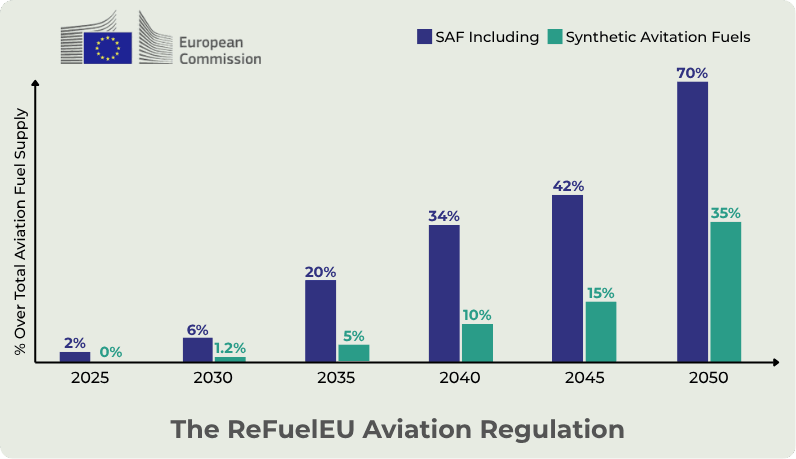
ReFuelEU (See: EU Climate Regulations Explained) defines SAF to include synthetic aviation fuels from renewable hydrogen and captured carbon, advanced biofuels, other eligible biofuels, and recycled carbon aviation fuels.
The issue is that mandates create demand, but they do not by themselves build plants. If eSAF is to become affordable and available at the volumes required by ReFuelEU, public funding and private capital must be directed into production capacity. ETS revenue is one of the few EU funding sources with a direct link between the polluting activity and the technologies needed to reduce it.
Why DAC is Part of the ETS Review
Direct Air Capture is included in the ETS review through the wider question of carbon dioxide removals. By 31 July 2026, the Commission must assess how greenhouse gases removed from the atmosphere and permanently stored can be accounted for and covered by the ETS.
This does not mean every use of DAC would count as a removal. DAC with permanent geological storage can generate negative emissions because CO₂ is removed from the air and stored for centuries. However, DAC used for eSAF is different. In that case, CO₂ is used as a feedstock and is later released when the fuel is burned. Even so, it can reduce dependence on fossil carbon because the carbon in the fuel has been taken from the atmosphere rather than extracted from oil, creating a closed loop.
DAC is Needed for Removals and for eFuels
DAC is poised to be a key player in decarbonisation because some emissions will remain difficult to eliminate fully. Aviation, agriculture and parts of heavy industry will have residual emissions even after fuel switching, efficiency gains and electrification. For these sectors, permanent carbon removals can balance emissions that cannot be cut at source. The EU’s 2040 climate target now includes the use of domestic permanent removals in the EU ETS as one of the post-2030 design options.
Why is this Relevant to eFuels?
DAC is also relevant for eFuels because synthetic hydrocarbons need a reliable source of CO2 feedstock. For eKerosene (eSAF), eMethanol and other eFuels, renewable hydrogen is combined with captured CO₂. In the short term, some CO₂ may come from industrial or biogenic sources. Over time, however, fossil point-source CO₂ should decline if industrial sites decarbonise. DAC can therefore provide a more durable and more pure source of carbon for synthetic fuels, provided the process is powered by low-carbon energy.
Therefore, DAC can support aviation’s net-zero pathway in two ways:
- DAC can supply atmospheric CO₂ for eSAF production.
- DACCS can provide permanent removal for residual aviation emissions.
Investment Rules will Matter as Much as Targets: The GBER Amendment
ETS revenue can help, but project developers also need finance rules that allow early projects to proceed. The draft General Block Exemption Regulation (GBER) shows that EU State aid rules have been adjusted to support green and digital investment, research, testing infrastructure and access to finance. It also notes that projects eligible for Innovation Fund support may qualify for more permissive access to finance as “innovative enterprises”. (NEG8 Carbon’s letter to the European Commission Directorate-General for Competition)
That point is relevant to DAC and eSAF because both face high early costs and scale-up risk. A strong ETS price signal can make fossil options more expensive, while ReFuelEU can create demand for SAF and synthetic fuels. However, public funding and State aid rules are needed to reduce the financing gap for early plants.
Key Dates in the EU ETS Review Process
- 1 January 2025: ReFuelEU SAF requirements began at 2% SAF, and aircraft operators began monitoring non-CO₂ aviation effects under the EU aviation MRV system.
- By 1 July 2026: The Commission must assess CORSIA and decide whether more EU action is needed for flights to and from Europe.
- By July 2026: the Commission is expected to bring forward the wider EU ETS review proposal.
- By 31 July 2026: the Commission must assess how permanent atmospheric removals, including DACCS, could be accounted for in the EU ETS.
- 31 December 2026: the current aviation “stop-the-clock” derogation ends.
- From January 2027: the EU ETS could apply to departing international flights if the legal conditions linked to CORSIA are met.
- By 31 December 2027: the Commission must report on non-CO₂ aviation effects and may propose ETS coverage for those effects.
- 2050: ReFuelEU requires 70% SAF and 35% synthetic aviation fuels at EU airports.
Conclusion
The 2026 ETS review goes beyond a dispute about airline costs. In fact, it is a test of whether Europe will use carbon pricing to fund the technologies that aviation needs next. For DAC and eSAF, ETS revenue would help move production from pilot to commercial scale.
Direct Air Capture sits between two linked issues: how EU ETS revenues can fund clean aviation technology and how DAC can supply the CO₂ needed for eSAF and permanent carbon removal.
For more on the EU ETS and CORSIA:
- NEG8 Carbon’s Dr David Mulrooney Sits at the EU Parliament Roundtable on the EU ETS Review
- CORSIA vs EU ETS