
eMethane vs eMethanol vs eSAF
3 June 2026
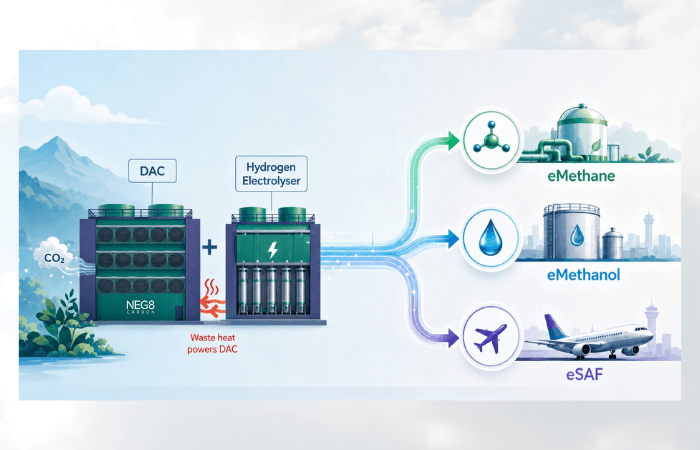
Carbon dioxide (CO₂) captured from Direct Air Capture (DAC) can be combined with green hydrogen to make synthetic fuels such as eMethane (synthetic natural gas, SNG), eMethanol and eSAF (electro Sustainable Aviation Fuel). How do these eFuels differ and what are the benefits and challenges of each?
It is worth noting that in an integrated eFuel plant, DAC (What is Direct Air Capture?) can be powered by recovered low-grade waste heat, including heat from a hydrogen electrolyser, depending on the DAC system used. This greatly reduces the energy cost of the DAC units.
Furthermore, to be considered as sustainable the hydrogen used in these fuels must be green hydrogen, meaning it should be made by splitting water using renewable electricity as the climate benefit value of eFuels depends heavily on the source of the electricity input and hydrogen used to make them.
A Closed Carbon Loop
When eMethane, eMethanol or eSAF is burned, CO₂ is released. However, their climate impact value comes from re-using the carbon already in the air for manufacturing the fuel thus avoiding extracting new fossil carbon.
Table Comparing eMethane, eMethanol and eSAF
| Heading | eMethane / Synthetic Natural Gas | eMethanol | eSAF / eKerosene |
| What it Is | A synthetic form of methane, made by reacting CO₂ with hydrogen. The process is often called CO₂ methanation or the Sabatier reaction. (More on eMethane) |
A synthetic liquid alcohol made by reacting CO₂, or CO₂-rich gas, with hydrogen over a catalyst. (More on eMethanol) |
A synthetic aviation fuel made from green hydrogen and captured CO₂, usually through Power-to-Liquid routes such as Fischer-Tropsch or Methanol-to-Jet (More on eSAF). |
| Physical Form | Gas at normal conditions | Liquid at normal conditions | Liquid aviation fuel |
| Main Use Case | Heavy transport, gas grid, LNG users, industrial heat | Shipping, chemicals, fuel blending, industry | Aviation |
| Indicative Production Cost | €155-€298/MWh OR €43-€83/GJ |
€170-€310/MWh OR €47-€86/GJ |
€217-€310/MWh OR €60-€86/GJ |
| Transport & Infrastructure | Can use gas pipelines, LNG trucks, ships and gas equipment but leak control is required | Liquid at ambient temperature and pressure, so it can be moved by ship, rail, road tanker and some pipeline systems | Drop-in fuel, can be blended into existing airport fuel systems and used in current aircraft |
Benefits & Challenges of eMethane, eMethanol and eSAF
eMethane
Benefits
- Can use existing natural gas pipelines.
- Can be transported as LNG by ship or truck.
- Can be used in existing gas engines, boilers and industrial gas systems.
- Useful where gas infrastructure already exists.
- Lower estimated cost than eMethanol and eSAF.
- Can support heavy transport, shipping and industrial heat.
Challenges
- Methane leakage can reduce the climate benefit.
- Methane slip from engines must be controlled.
- Liquefaction and compression if needed adds cost.
- New gas infrastructure may be needed in some areas.
- It may keep users dependent on methane-based systems.
- Strict monitoring is needed across production, storage and transport.
eMethanol
Benefits
- Liquid at normal temperature and pressure (easier logistics than gaseous fuels).
- Easier to store than eMethane and hydrogen.
- Can be moved by ship, rail, road tanker and some pipelines.
- Suitable for shipping fuel.
- Can also be used as a chemical feedstock.
- Ports already handle methanol in many locations.
Challenges
- Lower energy density than diesel, fuel oil and jet fuel.
- More storage space is needed.
- Engines may need to be replaced or modified.
- Methanol is toxic so handling controls are needed.
- Current production cost is still relatively high.
- Large-scale supply is still limited.
eSAF
Benefits
- Best suited for aviation.
- Can be blended with conventional jet fuel.
- Can be used in current aircraft.
- Can use existing airport fuel systems.
- Strong policy support in the EU.
- Useful for long-haul aviation where batteries are not practical.
- High-value market because aviation has few low-carbon options.
Challenges
- Usually the most expensive of the three fuels discussed here.
- Most complex production route of the three.
- Needs fuel upgrading and certification.
- Current supply is very limited.
- Production needs large amounts of renewable electricity.
- Scale-up is capital-intensive.
Summary
The best fuel choice depends on the final use.
eMethane is the strongest option where the customer already needs a gas and where existing natural gas infrastructure can be used. It has the lowest production cost of the three but methane leakage is an issue.
eMethanol is the better fit where a liquid fuel or chemical feedstock is needed, especially for shipping and industry. It has the strong logistics case but lower energy density means more storage volume.
eSAF is the most targeted solution for aviation where liquid fuel is still needed and EU policy is driving demand. While it is the best fit for aviation, it is usually the most costly and energy-intensive.
For all three, the same basic rule applies: the CO₂ should come from a credible low-carbon source such as DAC, the hydrogen must be green, and the process should make use of available heat where possible.