
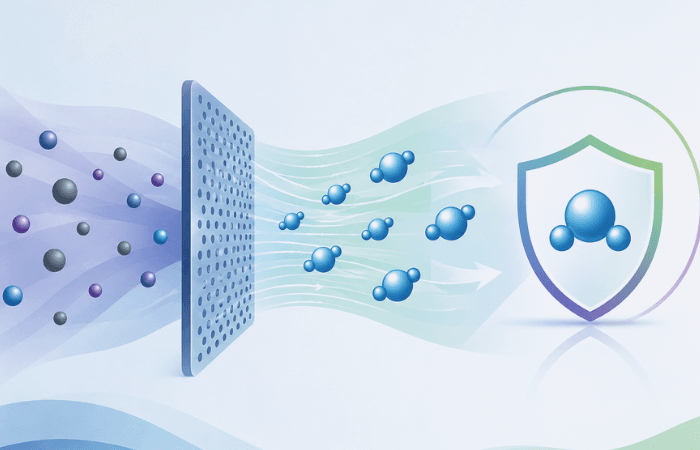
Purity of DAC CO2 Compared to Point Source CO2 and Biogenic CO2
5 August 2026
All methods to capture carbon dioxide (CO₂) can ultimately produce high-purity CO₂. However, the number and quantity of impurities in the raw gas captured are different and the amount of purification required before the CO2 is pure enough to be stored underground or used as a feedstock therefore also differs.
Among other methods, CO₂ can be captured using Direct Air Capture (DAC) and industrial point source capture or alternatively recovered from biological processes with biogenic carbon capture. (See: Carbon Dioxide Removal Technologies) How do these three processes work and what impurities does the CO2 contain for each?
DAC CO₂
Direct Air Capture removes CO₂ directly from ambient air. (See: How does Direct Air Capture Work?) The released gas is then dried, purified and compressed. Current DAC systems can produce CO₂ at more than 95% purity, while some processes describe their output as a near-pure CO₂ stream. Further purification can be added when a higher product grade is required.
Likely impurities include water vapour, nitrogen, oxygen and argon while trace contaminants may also come from ambient air or the sorbent. Their presence depends on the DAC process in question and the DAC plant location.
Point Source CO₂
Point source CO₂ is captured from a fixed industrial facility, such as a power plant exhaust, before it can be released into the atmosphere.
Expected impurities include water vapour, nitrogen, oxygen, NOₓ, SOₓ, carbon monoxide, particles and source-specific organic compounds.
Biogenic CO₂
Biogenic CO₂ is produced when biomass is fermented, digested, gasified or burned. Common sources include ethanol plants, breweries, anaerobic digestion plants and biomass facilities.
- During fermentation, sugars are converted into alcohol and CO₂ and the resulting gas can contain up to 99% to 100% CO₂ before final cleaning. Small amounts of water, ethanol, acetaldehyde and other organic compounds may remain.
- Anaerobic digestion produces biogas containing approximately 60% methane and 40% CO₂. During biomethane upgrading, the methane and CO₂ are separated and the separated biogenic CO₂ stream is commonly between 96% and 99% pure. To remove methane and other impurities, the gas is compressed, dried, liquefied and distilled.
- CO₂ recovered from biomass combustion or gasification normally requires more treatment. These sources may contain nitrogen, oxygen, carbon monoxide, sulphur compounds and nitrogen oxides.
CO₂ Purity
Taking food and beverage grade purity as an example, none of the capture methods automatically produce this grade of CO₂ purity. For comparison, beverage grade CO₂ normally requires a minimum purity of 99.9%. Using the ISBT/CGA beverage grade CO₂ spec as the standard benchmark for high-purity CO₂, limits include:
- Oxygen: 30 parts per million
- Moisture: 20 parts per million
- Carbon monoxide: 10 parts per million
- Total hydrocarbons: 50 parts per million
- Acetaldehyde: 200 parts per billion
- Total sulphur: 100 parts per billion
- Ammonia: 2.5 parts per million
Purity of CO₂ Required to Make eFuel
For most catalytic eFuel routes, feed CO₂ should be at least 99.9% pure, with total residual gases near 0.1%.
These limits show that bulk CO₂ purity is only one part of gas quality. A gas may be 99.9% CO₂ but still fail a product standard because a specific impurity exceeds its permitted limit.
DAC vs Point Source vs Biogenic Impurity Table
| Impurity | DAC CO₂ | Point Source CO₂ | Biogenic CO₂ |
|---|---|---|---|
| Water vapour | May be present after sorbent regeneration or liquid processing. | Common in combustion flue gas and many process exhaust streams. | Common in raw fermentation, digestion and flue-gas streams. |
| Methane | Not normally present, apart from trace levels in ambient air. | Usually low in complete combustion flue gas but may occur in natural gas processing, reforming or incomplete combustion. | A main impurity in CO₂ recovered during biomethane upgrading. |
| Nitrogen, oxygen and argon | Possible residual gases because they are present in ambient air. | Often major components of post-combustion flue gas because air is used for combustion. | May enter through air leakage, combustion or gas separation. |
| Sulphur compounds | Not normally produced by DAC, but trace process contamination must be checked. | SOₓ may occur in coal, oil, cement and refining flue gas. H₂S or COS may occur in syngas and natural-gas processing. | May occur in anaerobic digestion, gasification and biomass combustion. |
| Ethanol and acetaldehyde | Not normally present unless introduced through process materials. | Not normally present in combustion flue gas, but may occur in chemical, solvent or ethanol production exhaust streams. | May occur in fermentation-derived CO₂. |
| Carbon monoxide, NOₓ and SOₓ | Not normally produced by DAC, although polluted air may contain trace levels. | Process-dependent impurities in combustion flue gas, especially from power generation, cement production, steelmaking and refining. | May occur in combustion or gasification streams. |
| Hydrocarbons and other organic compounds | May come from ambient air or degradation of capture materials. | May arise from incomplete combustion, refining, chemical processing or fuel handling. | May come from feedstock breakdown, fermentation or biogas. |
| Particles and process droplets | Dust or sorbent particles may be present before filtration. | Fly ash, soot, cement dust, aerosols or process droplets may be carried in the raw gas. | May be carried from fermentation vessels, digesters or flue gas. |
Note: Actual concentrations will depend on the source and purification system.
CO₂ Gas Purity Tester
A CO₂ gas purity tester is used to measure the CO₂ concentration and identify trace impurities.
A full testing system may include:
- An infrared analyser for CO₂, carbon monoxide and organic compounds
- An oxygen analyser for trace oxygen
- A moisture analyser for water vapour
- Gas chromatography for hydrocarbons and volatile compounds
- A sulphur analyser for hydrogen sulphide and other sulphur compounds
A basic purity tester may only measure the total percentage of CO₂ and it may not detect low concentrations of benzene, sulphur, acetaldehyde or other compounds. Therefore, full impurity testing is needed for food, beverage and chemical applications.
Conclusion
When comparing the sources, DAC provides the most consistently pure raw captured CO₂ before final purification or conditioning, although fermentation-derived biogenic CO₂ and some industrial process streams may have a higher CO₂ concentration.
The overall conclusion is that raw DAC CO₂ is generally consistent, biogenic CO₂ ranges from methane-rich biogas to fermentation gas above 99% CO₂, while standard post-combustion point source gas often contains large amounts of nitrogen and oxygen. Therefore, DAC CO₂ generally requires less contaminant removal to reach a high-purity specification.
For more:
Sources:
- ISBT Carbon Dioxide Guidelines (via Linde ISBT_CO2.pdf) : Purity, H2O, O2, NH3 limits
- ISBT CO2 2010 guidelines (Scribd copy) : Full impurity table including NH3 (2.5 ppm) and sulphur action threshold (0.1 ppm)
- Brewers Association : “Understanding and Ensuring CO2 Supply Quality”
- Science Direct: “Sulfur tolerance of methanol synthesis catalysts: Modelling of catalyst deactivation”
- Energy & Environmental Science: “Power-to-liquid via synthesis of methanol, DME or Fischer–Tropsch-fuels: a review”
- ScienceDirect: “Assessment of carbon dioxide quality from industrial point sources for carbon utilization”
Interested in NEG8 Carbon’s CO2 capture technology?