
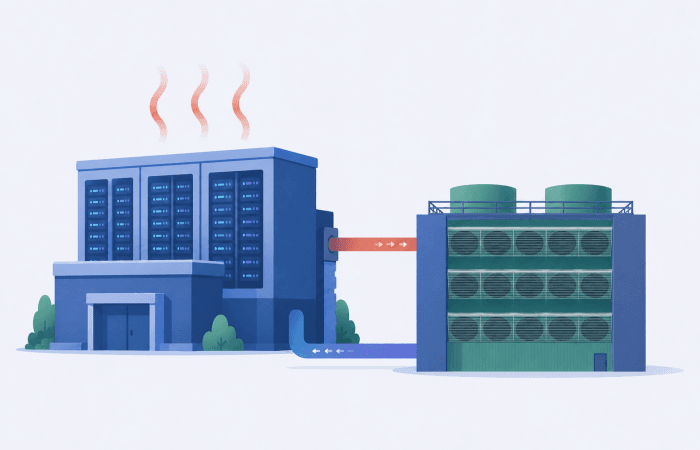
What Waste Heat Reuse Does for Data Centre Approvals
6 July 2026
By Dr David Mulrooney, Head of Business Development at NEG8 Carbon
Until recently, waste heat reuse has been treated as an environmental add-on for data centres. But now it is becoming a planning tool.
In markets facing community opposition and regulatory scrutiny, a data centre that can show useful output beyond its site starts from a stronger position. In fact, waste heat reuse may become the most important factor in determining whether a data centre gets built at all.
The Data Centre Permit Delay Problem is Real and Quantifiable
Planning delays carry a direct commercial cost. Every day of delay is a day of revenue not being earned, and therefore, technologies that reduce community opposition and accelerate planning approval are highly sought after.
Direct Air Capture (DAC) is such a technology as certain DAC technologies can use data centre waste heat to power the DAC process.
Data Centre Decarbonisation and Community Benefits
Planning objections tend to cluster around four areas:
- Electricity demand
- Water use
- Noise impact
- Local benefit
Waste heat reuse speaks directly to that fourth concern, and in NEG8 Carbon’s DAC technology case, it can also help address the first two.
Tallaght in South Dublin provides a working Irish example of data centre waste heat use. Waste heat from a nearby Amazon data centre supplies 100% of the heat to the Tallaght District Heating Scheme, which serves South Dublin County Council buildings and TU Dublin Tallaght. SEAI states that the scheme helps reduce local emissions by almost 1,500 tonnes of CO₂ per year.
Denmark shows the same planning logic at a larger scale and it has mandated that data centres integrate with district heating networks. In Odense for example, surplus heat from Meta’s data centre is recovered through an energy centre and supplied to the city’s district heating network. Communities that had initially questioned the value of a hyperscale facility began to understand the benefit in the most tangible possible terms: lower heating bills.
The EU Energy Efficiency Directive (Article 12) is now being institutionalised in national legislation across member states. The directive requires that data centres above 500kW IT load must report on waste heat recovery. Furthermore the EU’s Green Deal, sets a goal for data centres to become climate-neutral and energy-efficient by 2030 (although this is not legally binding). Germany has gone further. New data centres entering operation from 1 July 2026 must meet waste heat utilisation requirements of 10%, rising to 15% in 2027 and 20% in 2028. This way forward is good news for decarbonising data centres. (See: EU Energy Efficiency Directive: Turning Data Centre Waste Heat into a Resource)
Direct Air Capture and Waste Heat Recovery for Data Centres
District heating works best in close physical proximity to an urban heating network where pipes, heat demand and urban density already exist. However, many data centres are built in rural or industrial locations, so a different waste heat route is needed. Several solutions are being considered.
Direct Air Capture is one of the strongest options. Solid sorbent DAC systems can use low-grade heat to release captured CO₂ and data centres produce a steady heat source that can be recovered.
Furthermore, DAC can returned cooled water to the data centre to help with the cooling function. Therefore, DAC delivers a carbon removal benefit, reduces the heat impact on the local environment and lowers the energy costs of cooling systems. Another added benefit in some DAC systems is that water is produced as a by-product which further helps reduce the impact on the local commuity’s resources.
Microsoft is already testing this concept. Its DACinDC pilot integrates Direct Air Capture into data centre infrastructure and uses waste heat from computing workloads to support carbon removal.
Another option for data centre waste heat reuse is atmospheric water generation to harvest water from ambient air. In essence, both water harvesting and DAC are planning arguments. They demonstrate that a data centre is not merely extracting from its host community but contributing to it. In markets where planning approval is the binding constraint on data centre growth (Ireland included) this goes beyond a sustainability metric to a commercial imperative.
Sustainable Data Centres Need a Waste Heat Plan
Waste heat reuse is becoming a planning and compliance issue.
Data centre developers should now treat waste heat use as part of the planning file from day one. A scheme that can support Direct Air Capture, heat buildings, recover water or supply nearby industry has a stronger story for planners and communities.
In the end, the data centre sector has a waste heat problem, while the planning system has a community benefit problem. Waste heat reuse can answer both at the same time.
For more:
- Sustainable Data Centres with Direct Air Capture
- AI for Good, Data Centre Growth and the Carbon Removal Link
- Data Centre Cooling Solutions with Direct Air Capture
- The Future of Data Centres: What LCAW Revealed
- The Data Centre Industry has a Problem. Actually, it has Three
- Green Energy Parks Should Include Direct Air Capture for Clean Growth
- Data Centre Sustainability Metrics Explained
- Direct Air Capture Using Waste Heat