
The Future of Data Centres: What London Climate Action Week Revealed
26 June 2026
By Dr David Mulrooney, Head of Business Development at NEG8 Carbon
London Climate Action Week (LCAW) is where policy, capital and climate technology meet. For NEG8 Carbon, the Sustainable Data Centres Forum: Accelerating Green Data Centre Solutions event was an education in how to approach decarbonising this essential infrastructure.
The event was hosted by the Danish Embassy, Invest in Denmark, the Net Zero Innovation Hub for Data Centres and the Danish Data Centre Industry.
As an Irish company, NEG8 Carbon is aware of the debates around the data centre challenges: energy demand and grid pressure along with planning delays, emissions and community concerns.
However, in London, the discussion was refreshingly positive, giving a strong signal. The focus shifted away from whether data centres should exist or not and was on how they should be designed and used as part of wider energy and carbon systems.
Four Points on Data Centres in Europe
1. Denmark has Moved from Hosting Data Centres to Shaping Their Future
One point became clear early in the session: Denmark is now one of Europe’s leading markets for net-zero data centre innovation. This has not happened by accident as it has been built through a clear policy environment, an active operator base and a strong innovation structure.
The Danish government’s three-phase model for data centre foreign direct investment was set out clearly:
- Availability in 2013.
- Responsibility in 2019.
- Value-driven growth today.
That progression says a lot about where the data centre industry is going.
In the first phase, data centre investment was driven by site availability, power access, fibre connectivity and market entry. In the second phase, responsibility became a larger factor, with more attention given to energy use, emissions and local impact.
Today, the expectation has moved forward again. Data centre investment is now being asked to show measurable value to society. That value can include grid support, heat recovery and water reduction. Other priorities include local jobs, lower emissions and integration with climate technology.
For operators, this changes the investment case, while for technology providers, it changes the route to market. And from a government perspective, it changes the standard by which projects are judged.
2. Denmark’s Net-Zero Innovation Hub Is Built for Deployment
A second major takeaway of the event was the role of the Net Zero Innovation Hub for Data Centres, based in Fredericia, Denmark. The NZIB’s approach is an example for other countries to emulate as they look for ways to make data centres sustainable.
The NZIB is backed by heavy weight industry participants, including Microsoft, Google, Amazon Web Services, Data4, atNorth, Danfoss, Schneider Electric, and Vertiv. Notably, the hub is an industrial route to deployment and is not seen as a passive research programme. This difference is the crux of the programme.
Operators define the requirements. Technology companies bring the solutions, while validation is carried out in real data centre environments. Furthermore, de-risking covers technical, commercial, regulatory and financial risks simultaneously.
For climate technology companies, this is the kind of structure that is often missing. Many good technologies struggle between pilot stage and commercial use because the route to validation is slow, fragmented or unclear.
The Net Zero Innovation Hub solves that problem by bringing operators, technology providers, infrastructure partners and funders into the same process. In essence, it is an industry-funded pipeline from innovation to GW-scale deployment.
Altogether, it is one of the most credible routes to market for sustainable data centre technology in Europe.
3. Waste Heat Reuse Is Becoming a Planning Issue
A third message came through strongly: waste heat use is becoming one of the main tests of whether a data centre can prove its value to a local area.
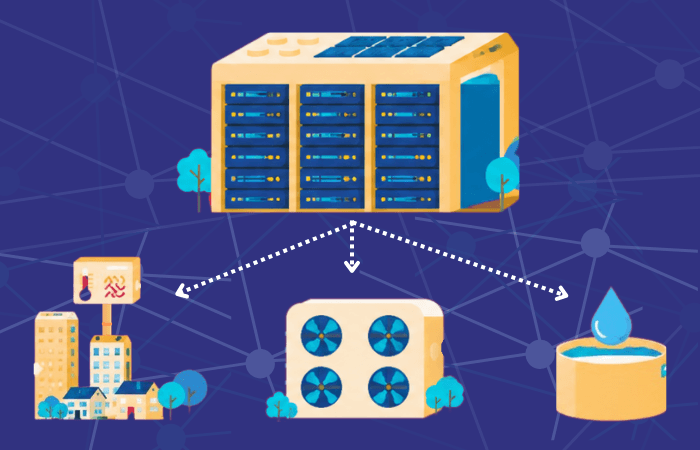
Across Europe, data centres are being assessed on what useful outputs they can provide, and waste heat use is driving that shift. Some use cases of waste heat include:
- Heat for carbon removal systems, such as Direct Air Capture
- Heat supplied for district heating
- Heat for nearby industrial users
- Heat used in water harvesting processes
Direct Air Capture (DAC) requires heat, while data centres produce heat. If that heat is recovered and used in the DAC capture process, a liability or stranded asset becomes an input. This points to waste heat being treated as a design factor, not as an afterthought.
4. Water is the New Carbon
Water was another major theme at the event as a large share of global data centre capacity is in water-stressed regions, which creates risk for operators, communities and permitting authorities.
Technologies that can produce water on-site from waste heat are now being taken seriously because water access is becoming a constraint on data centre growth. Certain DAC technologies, as is the case with NEG8 Carbon’s DAC, also produce water as part of the carbon capture process. Another example is AirJoule, a joint venture between GE Vernova and Montana Technologies, which presents a clear example of where the market is heading.
This is a major shift. For years, carbon has been the main environmental metric in corporate climate strategy, and although carbon issues are still at the forefront of climate activities, water is moving quickly up the agenda.
Communities are asking how much water data centres use and rightfully so. Planning authorities are asking whether municipal and groundwater supplies will be affected and operators are asking how water risk can be reduced before it delays projects.
All these pressing issues create a new category of value. A data centre that can use its waste heat to produce water, support district heating or enable carbon removal has a different relationship with its host community. In this scenario, it becomes part of a wider resource system rather than being only a large energy user.
Ireland Understands the Problem; Denmark Has the Model Solution
Ireland understands the data centre problem well and has grappled with grid capacity, renewable electricity supply, planning concerns and public acceptance. What Denmark showed during London Climate Action Week is that the answer is to set a higher standard and act on it.
Data centres should be expected to prove value beyond the site boundary. This approach involves planning waste heat usage, carbon removal and water impact measure right from the start.
Moving Ahead with Data Centre Sustainability
NEG8 Carbon left the event with new conversations, a clearer view of market direction and a sharper sense of where sustainable data centre infrastructure is heading. What you do with carbon, heat and water is the differentiation, and for climate technology companies, this creates a serious commercial opportunity. In future, data centres be judged by what they give back.
For more:
- Sustainable Data Centres with Direct Air Capture
- AI for Good, Data Centre Growth and the Carbon Removal Link
- Data Centre Cooling Solutions with Direct Air Capture
- The Data Centre Industry has a Problem. Actually, it has Three
- What Waste Heat Reuse Does for Data Centre Approvals
- Green Energy Parks Should Include Direct Air Capture for Clean Growth
- Data Centre Sustainability Metrics Explained
- Direct Air Capture Using Waste Heat