
Sustainable Plastic Manufacturing
31 March 2026
By: Dr David Mulrooney and Jeannie De Vynck
Sustainable plastic manufacturing involves three main drives: decarbonisation, circularity and carbon management.The plastics industry has long been discussing how to decarbonise, and the solution requires a multi-faceted approach, which should include Direct Air Capture (DAC) as it offers a way for CO₂ to be removed from the air and then reused as a feedstock in the plastic production itself.
Why Plastics are Hard to Decarbonise
Of all the major industrial materials, plastics are arguably the hardest to decarbonise. Steel and cement benefit from chemical transformation pathways, and aviation has synthetic fuels as an option.
But with plastics, fossil fuels don’t just power their production, they are the product.
Around 90% of plastics are made from coal, oil and gas, and so even in a world running on clean electricity, the CO2 feedstock problem would remain.
The process is energy-intensive from the very first step. Fossil fuels must be extracted and refined, then cracked into monomers such as ethylene, before being polymerised into the resins that become products. Roughly 75% of plastic’s lifecycle emissions are generated before polymerisation even begins. That means simply swapping out process heat for green electricity addresses only a fraction of the problem.
The Plastics Market and Carbon Footprint are Large
Global plastics production reached 430.9 million tonnes in 2024, while Europe produced 54.6 million tonnes and recorded about €398 billion in turnover in the same year. For global market value, published estimates vary by scope and coverage but is estimated at $650 billion per annum. In other words, plastics are not a niche materials segment. They sit at the centre of packaging, construction, healthcare, transport, electronics and consumer goods: the full spectrum of our lives.
The climate burden from plastics is enormous. Research from Lawrence Berkeley National Laboratory (2019) puts global plastic production emissions at around 2.24 gigatonnes of CO₂ equivalent per year, which is equivalent to the annual output of around 600 coal-fired power plants, and more than the combined emissions from global aviation and shipping. That figure represents approximately 5.3% of total global greenhouse gas emissions and will rise. Under the industry’s historical 4% growth rate, the figure could rise to 6.78 gigatonnes by 2050.
The carbon intensity varies by polymer type, with PVC carrying the heaviest burden at around 7.83 kg of CO₂ equivalent per kilogram produced.
What the Plastics Industry is Doing to Make Low-Carbon Plastic
The plastics industry is not standing still and is putting into place some impactful solutions. The main industry response has been split across two tracks.
- Demand for fossil feedstock is being reduced through reuse, product redesign, recycling, and more circular business models.
- Production itself is being cleaned up through energy efficiency, low-carbon electricity, low-carbon fuels and carbon capture and storage.
In 2024, fossil-based plastics still made up 89.8% of global production, while carbon-captured plastics remained below 0.1% of the total. In Europe, circular plastics represented 15.4% of production in 2024.
DAC’s Role in Decarbonising the Plastics Industry
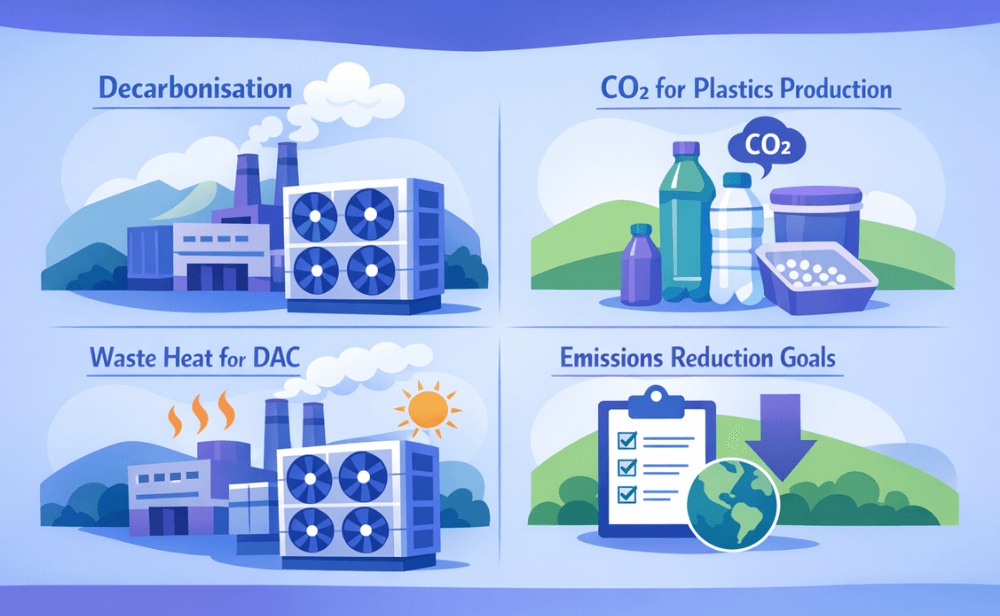
Even in a more circular system, the plastics sector will still need a carbon feedstock source. Direct Air Capture offers the plastics industry:
- Decarbonisation
- A source of CO2 for plastics production
- Can use industrial waste heat to power DAC
- Compliance with emissions reduction goals (see: EU Climate Regulations Explained)
DAC works by pulling CO₂ directly from the atmosphere (see: How does Direct Air Capture Work?). The captured CO₂ is then compressed and delivered as a purified gas, either for permanent geological storage or for use as a feedstock in industrial processes, such as in plastics manufacture. For more details, see The Advantages of Direct Air Capture.
The long-term value of DAC is that it can provide atmospheric carbon after fossil point sources start to decline. Many cracking and polymerisation facilities emit CO₂ at concentrations or with purity issues that make point-source carbon capture impractical. However, DAC sidesteps these problems, offering a supply of CO₂ that is pure and that can be captured from the atmosphere at any location.
Captured CO2 as a Plastics Feedstock
The idea of using CO₂ as a raw material for plastics is already in commercial production. Carbon dioxide can be used to make certain plastics by acting as a feedstock in chemical reactions, which helps reduce the need for some fossil-based feedstocks. This approach can help lower emissions when the CO2 is captured directly from the air with DAC or at point source, and when low-carbon energy is used in the process.
There are two main routes.
1. Direct Incorporation
This is where CO₂ is reacted into polymer intermediates or polymers themselves, typically through reactions with epoxides to form polyols or aliphatic polycarbonates. German chemical giant Covestro pioneered this approach with its breakthrough Dream Chemistry platform. Its Dormagen facility in Germany uses captured CO₂ and converts it into polyol.
2. Indirect Conversion
This is where CO₂ is first turned into another molecule, most notably methanol, and then processed into olefins such as ethylene and propylene, which are then polymerised into standard plastics such as polyethylene and polypropylene.
The CO₂-based plastics segment (the emerging market for polymers made using captured carbon) is still a small percentage of the total but it is growing at a compound annual rate of nearly 12%.
Examples of Plastics Using CO2 as a Feedstock
*wt% is “weight percent” which is the percentage of the total weight
| Material | Main uses | Approx. CO₂ % |
| Polycarbonates (PC) | Safety glasses, automotive headlamp lenses, electronic housings, greenhouse glazing, optical discs | Approx. 17 wt% max in finished BPA-PC as a simple stoichiometric upper bound. A single commercial wt% is not usually quoted for finished PC. |
| Polyurethanes (PU) | Mattresses, insulation panels, car seating, footwear soles, adhesives, coatings | Up to 20 wt% in the CO₂-based polyol precursor. The final PU part is usually lower because the full formulation also contains isocyanates and other components. |
| Polypropylene carbonate (PPC) | Packaging films, agricultural mulch films, adhesives, foams, biodegradable packaging | Approx. 43.1 wt% chemically bound CO₂ |
| Polyethylene terephthalate (PET) | Bottles, trays, packaging films, polyester clothing | Approx. 30 wt% in the current commercial route because the MEG portion of PET is replaced by captured-carbon-derived MEG |
| Polyethylene (PE) | Bags, bottles, pipes, agricultural film | Up to 100% of the polymer carbon can be captured-carbon-derived in the drop-in route |
| Cyclic carbonates | Solvents, battery electrolytes, chemical intermediates | Approx. 43 to 50 wt%, depending on the carbonate. For example, propylene carbonate ≈ 43.1 wt% and ethylene carbonate ≈ 50.0 wt% |
| Urea-formaldehyde and melamine-formaldehyde resins | Wood panel adhesives, laminates, moulded products | UF: the urea component is ~73.3 wt% CO₂ by stoichiometry; Fertilizers Europe states ~0.7 t CO₂ stored per tonne of urea used in glues. MF: Fertilizers Europe states ~1 t CO₂ stored per tonne of melamine. The final resin value varies with resin formulation. |
| Polyhydroxyalkanoates (PHAs), including PHB | Packaging, furniture, accessories | No single fixed wt%. The route is greenhouse-gas-derived and can include methane, so the exact CO₂ share is route-specific. |
| PMMA (acrylic glass) | Display screens, lighting fixtures, signage, automotive glazing | Approx. 31 wt% if only the methanol-derived part is CO₂-derived. This can be higher if the methacrylic acid route is also decarbonised. |
NOTE: The CO₂ % column has been interpreted as the approximate share of the product, or its direct precursor route, that can come from CO₂-based feedstock. For PPC and cyclic carbonates, CO₂ is chemically built into the molecule. For PE, PET, PMMA, PHAs, and UF/MF resins, the figure is route-dependent because CO₂ is first converted into another intermediate such as ethanol, methanol, MEG, or urea. The PC figure is a calculated upper bound, not a standard supplier value.
Replacing Current Industrial CO₂ Sources with DAC Captured CO₂
At present, most CO2 used in chemicals and polymer routes still comes from industrial point sources. However, the International Energy Agency (IEA) also states that for CO2 use to stay compatible with a net-zero pathway, the CO2 ultimately needs to come from biomass or the air, i.e. Direct Air Capture. It is not just about removing carbon. It is about replacing fossil carbon with atmospheric carbon in cases where new material feedstock is still needed.
Conclusion
The catalyst for sustainable plastics manufacture will be a combination of policy, technology and corporate commitments that tip the balance towards decarbonising plastics. Direct Air Capture is not a substitute for circularity. It is a complement to it, and for some high-volume plastics, it may become one of the few routes that can support deep decarbonisation while preserving the function of the material.
For more:
- Industrial Decarbonisation with Direct Air Capture
- Decarbonising Construction by Storing CO2 in Concrete
- Decarbonising the Steel Industry
- Sustainability in the Chemicals Industry
- Direct Air Capture Decarbonises Hard to Abate Industries