
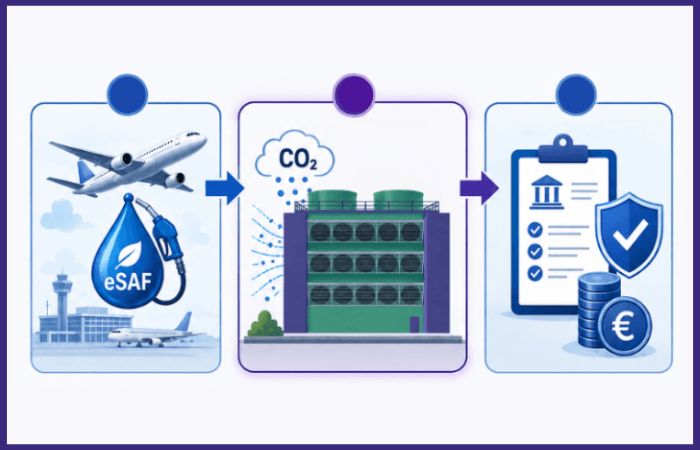
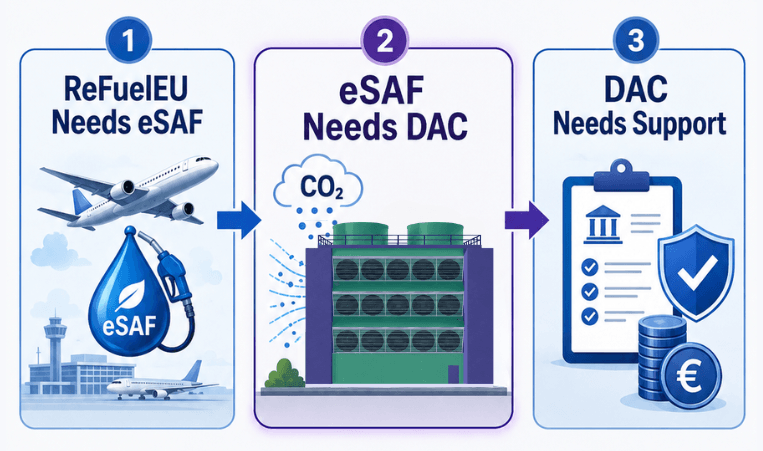
ReFuelEU Needs eSAF, eSAF Needs Direct Air Capture and Direct Air Capture Needs EU Support
12 August 2026
By Dr David Mulrooney and Jeannie De Vynck
The EU has mandated eSAF but now it needs to make sure there is enough sustainable CO₂ to produce it. And Direct Air Capture (DAC) has emerged as the best source of this CO₂. In light of this, the EU needs to provide dedicated funding for Direct Air Capture development, with some of the EU ETS revenue being ringfenced for DAC.
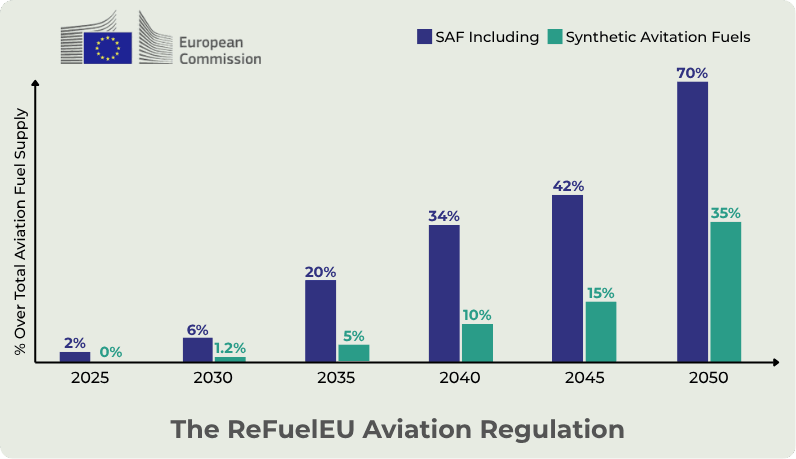
Under ReFuelEU Aviation, Sustainable Aviation Fuel must account for 20% of fuel supplied at EU airports by 2035, including a minimum 5% synthetic aviation fuel (eSAF, electro Sustainable Aviation Fuel). This creates a market demand for eSAF, however, regulations alone will not build the plants needed to supply it.
Direct Air Capture is the Best Source of CO₂ for eSAF
eSAF is made from renewable hydrogen and captured CO₂ with Direct Air Capture standing as the frontrunner to provide this CO₂ sustainably and in the amounts required.
Biogenic CO₂ can support early eSAF and eFuel production but sustainable biological CO₂ has a supply issue and cannot be treated as an unlimited feedstock. Furthermore, organisations such as the European Maritime Safety Agency (EMSA) acknowledge DAC is required for eFuel production at scale.
Meanwhile, fossil point source CO₂ cannot provide a long-term route under EU RFNBO (Renewable Fuel of Non-Biological Origin) rules. It is in a transitional window at the moment which ends at the end of 2035 for electricty generation emissions and the end of 2040 for industrial point source.
That leaves DAC as the best scalable source of sustainable CO₂ needed to support future eSAF, eMethanol and other RFNBO fuels.
Note that if Europe wants to build a credible eSAF industry, DAC capacity needs to be developed now in order for the ReFuelEU mandates to be met in time.
Therefore, if Europe wants eSAF at scale then DAC needs to scale. Now that ReFuelEU has created the demand for eSAF, and therefore DAC, it needs to support the infrastructure required to meet it.
Offtake Agreements for eSAF Needed to Drive Investment
There is another barrier: price.
According to the EASA’s 2025 Aviation Fuels Reference Prices, SAF costs around 3 times as much as conventional jet fuel while eSAF is about 12 times as much.
Clearly, that price gap cannot remain if ReFuelEU mandates are to be fulfilled.
However, many of the technologies involved are still at an early commercial scale. As larger eSAF plants are built, renewable hydrogen expands and DAC deployment increases, costs will fall.
But scale requires investment, and investment requires confidence that somebody will buy the fuel. That is where long-term eSAF offtake agreements become important.
eSAF Offtake Agreements Can Unlock Final Investment Decisions
More than 40 European eFuel projects have been reported at the planning stage yet many still need to reach final investment decision (FID).
For project developers, the problem is clear. Large eSAF facilities require substantial upfront investment, so lenders and investors need confidence in future revenue and long-term offtake agreements provide that confidence.
Airlines and fuel buyers can commit to purchasing agreed volumes over several years, and as a result, future revenue becomes more predictable, project finance becomes easier to secure and projects have a better chance of reaching FID.
ReFuelEU Penalties Alone Will Not Build an eSAF Industry
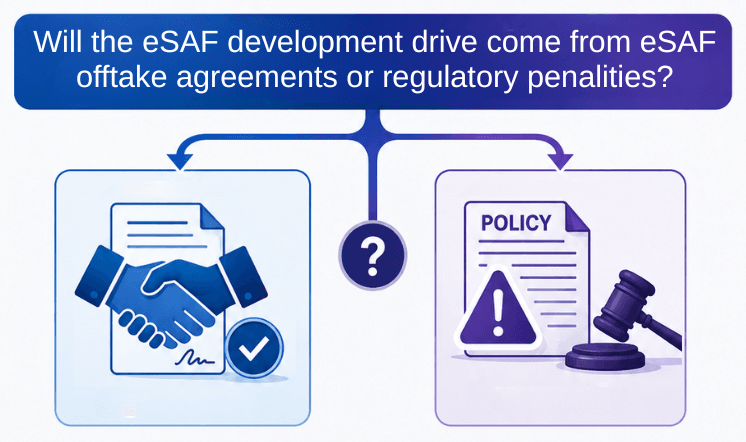
Undoubtedly, ReFuelEU needs enforcement, however, penalties cannot be the main mechanism for developing eSAF supply.
While regulations are there to create the eSAF requirement in the first place, the concern is whether Europe can create enough bankable demand for producers to invest billions of euros in new capacity.
The next 12 to 18 months could therefore have a major influence on Europe’s ability to meet its 2030 eSAF requirements. Every delay reduces the time available for financing, engineering and construction, followed by commissioning and production ramp-up.
EU ETS Support for eSAF
The proposed revision of the EU Emissions Trading System (ETS) provides an encouraging signal.
The existing aviation SAF support mechanism allocated 20 million allowances between 2024 and 2030. Under the proposed revision, up to a further 110 million allowances could support eligible aviation fuels between 2028 and 2040. For RFNBO aviation fuels such as eSAF, the proposal could cover 60% of the remaining price difference with fossil jet fuel.
Notably, the proposal also recognises longer term fuel supply contracts. This could strengthen the connection between EU support and the offtake agreements needed to finance new plants.
However, eSAF will still compete within a wider SAF support structure which does not take into account the reliance on DAC for scaling eSAF production.
Ringfenced EU Funding for DAC Development
The new Industrial Decarbonisation Bank (IDB), launching in 2028, is scoped to Annex I stationary installations only, i.e. cement, lime, waste incineration, etc. DAC cannot access it. DAC is left competing within the existing Innovation Fund, with no dedicated instrument of its own. This is driven by the commitment of the EU to reinvest penalties paid by heavy emitters back into their industries.
The IDB should step up and mandate DAC funding given that DAC is the only CO2 source that can supply eSAF at scale with no post-2040 sunset. EU ETS revenues could help finance DAC manufacturing, deployment and infrastructure where atmospheric CO₂ is supplied to qualifying RFNBO projects. In turn, greater DAC deployment could expand supply and help reduce costs across both carbon utilisation and permanent carbon removal markets.
Conclusion: Scaling eSAF and Direct Air Capture Together
Europe has already taken the first step by creating mandatory demand for synthetic aviation fuel but now supply needs to catch up.
Above all, eSAF developers need customers willing to make long-term commitments. Policy support can reduce the initial price gap and EU ETS funding can provide further support, yet it is long-term offtake agreements that can turn planned projects into financed projects.
ReFuelEU has created the destination and now the EU needs to finance the route to get there.
For more:
- eSAF is More than a Climate Solution, it is a Fuel Security Asset
- Lift Off for NEG8 Carbon in Sustainable Aviation Fuel
- The Path to Sustainable Aviation White Paper by Prof. Don MacElroy
- EU Climate Regulations Explained
Sources:
- European Commission – ReFuelEU Aviation
- European Commission – EU launches eSAF Early Movers Coalition
- European Commission – Sustainable Transport Investment Plan
- EASA – 2025 Aviation Fuels Reference Prices
- EASA – ReFuelEU Aviation Annual Technical Report 2025
- European Commission – EU ETS Review Impact Assessment, Part 3
- European Commission – EU ETS Review Impact Assessment, Part 2