
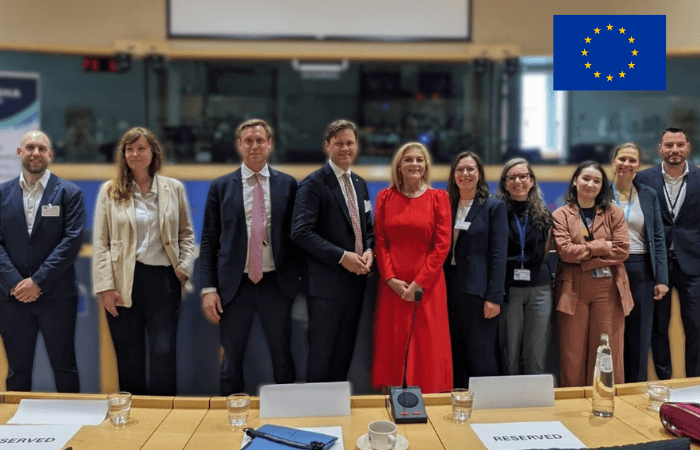
NEG8 Carbon Sits at the EU Parliament Roundtable on the EU ETS Review
9 June 2026
With the review of the EU Emissions Trading System (ETS) coming up in July 2026, the SASHA Coalition convened a roundtable event at the European Parliament to shine a spotlight on the importance of extending the EU ETS to include international flights departing the EU and what that means to decarbonising aviation.
The event, “EU ETS Revision and Scaling eSAF for Competitive Aviation” was hosted by Cynthia Ní Mhurchú, MEP.
“The decisions we make today are going to affect our future, and that is why regulatory certainty really really matters.”
Cynthia Ní Mhurchú, MEP
Dr David Mulrooney, Head of Business Development at NEG8 Carbon, sat on the panel “Pathways to Decarbonise Aviation: CORSIA and the EU ETS” and had this to say:
Question 1
“Would you introduce yourself and your company and explain what role the EU ETS plays in your business model or your strategy”
NEG8 Carbon is an Irish deepTech company based in Waterford. We develop modular Direct Air Capture (DAC) technology designed to extract carbon dioxide directly from the atmosphere to decarbonise industries and combat global warming. Using NEG8’s unique electrostatic DAC system and specialised sorbents, the company captures CO₂ that can be permanently stored underground or repurposed into sustainable, climate-neutral products like sustainable aviation fuel (eSAF). And we do this using low-grade industrial waste heat that a production facility would otherwise discard, making DAC affordable and scalable. That is what makes our process commercially distinct.
The role of ETS in NEG8 Carbon’s strategy
To answer your question directly: the EU ETS is foundational to our commercial strategy. NEG8 supplies atmospheric CO₂ capture. The stronger and more consistent the carbon price signal, the stronger the investment case for the infrastructure we sell into. ETS is not a policy backdrop for us. It is the market mechanism our business is built on.
Why DAC connects to aviation
CO₂ is critical to making eSAF.
eSAF (electro-Sustainable Aviation Fuel) is produced from renewable hydrogen and captured carbon. Therefore, no CO₂, no eSAF. And eSAF production has to scale dramatically to meet ReFuelEU mandates and the obligations that follow from them.
The most reliable and sustainable source of that CO₂, at the volumes required, is Direct Air Capture. Not industrial point sources as those will decline as industries decarbonise. And not biogenic sources alone as there simply isn’t enough biogenic CO₂ feedstock available to produce the eSAF volumes the mandates demand.
We need DAC and DAC at scale.
To get DAC to that point, you need funding: substantial, sustained funding. And EU ETS revenues, extended to cover international aviation, can provide exactly that.
That is the chain and that is why a DAC company is sitting at an aviation table today.
The ETS track record and the gap
The EU ETS works. It has been operating for over twenty years and has successfully driven emissions reductions across almost every major industrial sector. The Paris Agreement reinforced that mission a decade ago and Europe has been leading on carbon pricing longer than most countries have been seriously discussing it. Save for aviation.
International aviation has largely sat outside the full scope of the ETS’s surrendering obligation. We didn’t include all flights, so we didn’t include all the emissions. I’m not here to bash a green drum about that but I’m here to highlight the money left on the table and the opportunity we now have to put it to work.
The ETS review is not a question of regulatory tightening. It’s a question of whether we use Europe’s most effective carbon pricing tool to fund the technologies aviation will depend on. That is the opportunity.
And that is why we are particularly glad to be at this table today. We’re here to discuss extending the ETS to international aviation and it happens to coincide with Ireland assuming the EU Council Presidency in July, which is the same month this decision lands. Ireland can be the broker of a growth agenda, not a penalty. That is the conversation we are here to shape.
Question 2
“There have been calls to implement CORSIA worldwide, Europe included. How would this impact your industry?”
CORSIA and ETS are different instruments
CORSIA and the EU ETS are fundamentally different instruments and I think it’s important to be honest about that rather than treating them as equivalent. CORSIA doesn’t account for emissions the same way the ETS does. It’s structured around offsetting the growth in international aviation emissions above a baseline and not pricing the full emissions footprint of a flight. The charges it imposes are lower, the offset quality is more variable and the environmental outcome is more uncertain.
I won’t sit here and cite figure for figure what the difference is as the Commission will do that in its assessment by the first of July. But the directional impact on my industry is significant. ETS revenue is what finances the Innovation Fund and it’s what will finance the proposed Industrial Decarbonisation Bank. On the other hand, CORSIA revenue doesn’t do that. It doesn’t build European clean technology and it doesn’t fund Irish deepTech. And notably, it doesn’t reduce the cost of making eSAF. (See: CORSIA vs EU ETS: Why the Difference is Relevant for Direct Air Capture and eSAF)
Empathy for airlines… up to a point
Many airlines are lobbying strongly for CORSIA to be upheld and I can genuinely empathise with their position: up to a point. Airlines want to protect their bottom line and their competitiveness and I understand that. Ireland’s own Ryanair is arguably the de facto leader in driving cost competitiveness across the entire industry and that’s not something to dismiss. The reality is straightforward: airlines will face charges and obligations one way or another. The regulatory direction is set and the question is not whether they face a carbon cost but it’s what that cost produces.
The opportunity
Under CORSIA, that money largely leaves Europe and it goes into offset projects of varying integrity around the world. However, under the EU ETS, that revenue stays here. It goes into the Innovation Fund, it funds first-of-a-kind eSAF production plants, it funds Direct Air Capture development, and it funds the home-grown European deepTech companies, companies like NEG8 Carbon, that are building the technologies airlines will need to actually decarbonise their fleets in the 2030’s and 2040’s.
The solar and battery industries proved something important. Clean technology does not need a microchip miracle to become affordable but it does need investment in manufacturing scale, in standardised design and in chemical process efficiency. The same transition is entirely possible for eSAF. With sustained investment, eSAF can move from a premium boutique product to an affordable, mass-market fuel. But that transition requires a funding mechanism with real scale behind it. The ETS provides that; CORSIA does not.
The economic case
So the impact on my industry of implementing CORSIA in place of the ETS is, simply put, that the economic foundation for the next generation of European aviation technology is undermined before it has a chance to be built. That’s the opportunity cost I’d ask this panel to weigh.
Question 3
“What does competitiveness mean for you? And on a world stage, in terms of pushing for innovation, what does that look like in practice?”
Reframe competitiveness
Competitiveness, to me, is not about protecting the margin you have today. It’s about building the capability you need for tomorrow. And I think there’s a risk in this conversation that we confuse the two.
When airlines argue for CORSIA on competitiveness grounds, what they’re really saying is: we want the lower-cost compliance option right now. And I understand that commercially but that’s not a competitiveness strategy, that’s a short-term cost management strategy. A genuine competitiveness strategy asks: what does the industry look like in 2035, and are we positioned to lead it?
The solar and battery precedent
We’ve been here before: look at solar, look at batteries. A decade ago, both were dismissed as too expensive, too niche, too dependent on subsidy to ever be commercially viable at scale. And then investment happened in manufacturing automation, in standardised designs and in chemistry and materials. And the result? Costs fell by orders of magnitude. Not because of a technological miracle but because of sustained, deliberate, well-funded industrial policy.
eSAF is at precisely that inflection point right now. It is expensive today but it will not always be expensive. However, it will only become affordable if investment happens now in production capacity, in CO₂ supply infrastructure, in Direct Air Capture and in green hydrogen. The EU ETS, extended to cover international aviation, is the mechanism that makes the economics of that investment work.
European and Irish industrial opportunity
On a world stage, what does pushing for innovation look like in practice? It looks like Europe deciding that the clean aviation supply chain – the electrolysers, the DAC units, the eSAF production plants – is built here, with European IP, generating European jobs. Ireland has done exactly this in pharmaceuticals and in tech where high-value, high-skill manufacturing is anchored to strong policy frameworks.
NEG8 Carbon is an Irish company where the talent building our technology is Irish and the intellectual property is Irish. And that distinction matters more than it may appear.
Ireland has built extraordinary prosperity on foreign direct investment, from technology multinationals that have made Dublin and Cork world-class centres of employment. We should be proud of that. But we’ve also learned, recently and quite sharply, how fragile that model can be. When a major technology company restructures its global operations, Irish workers bear the cost of decisions made thousands of miles away. Those jobs can leave and they can leave quickly.
Indigenous deepTech is different. Jobs built on Irish IP, funded by European policy, and commercially anchored to production infrastructure here are jobs that don’t move when a head office changes its mind. They compound, they create supply chains, graduate pipelines and export capability that stays in Ireland and in Europe.
ETS revenue invested in DAC development, in eSAF production capacity, in companies like NEG8 is what building a European-built clean technology industry looks like in practice. That is the durable economic dividend that this policy decision can unlock.
The Ask
Competitiveness on a world stage means building things the world will need. The world will need affordable sustainable aviation fuel and the world will need Direct Air Capture at scale. And Europe is genuinely positioned to lead in both.
Ireland assumes the Council Presidency in July. The ETS revision lands in July. That is not a coincidence to let pass quietly. Ireland has the chair at precisely the moment this decision is made. Now, the question is what Ireland does with it.
My view is simple. Use it to push the agenda, not of penalising aviation, but of spearheading Europe’s continued strategic growth in the industries that will define the next twenty years. Extend the ETS to cover international aviation. Direct the revenue into DAC and eSAF. Let the cost curve do what it did for solar and for batteries.
That is what an ambitious Irish Presidency looks like in practice.
At the roundtable, there were keynote speeches from:
💠 Cynthia Ní Mhurchú MEP, Renew Europe
💠 Aoife O’Leary, CEO of Opportunity Green and Director of the SASHA Coalition
💠 Lydia Rooney, Transport Attache and Aviation lead for the Permanent Representation of Ireland to the EU
Panel – Pathways to Decarbonise Aviation: CORSIA and the EU ETS, with:
💠 David Mulrooney, Head of Business Development at NEG8 Carbon
💠 Polona Gregorin, Head of Unit Mobility at DG CLIMA
💠 Anders Fagernæs, Vice President, Sustainability at Norwegian
💠 Aoife O’Leary, CEO of Opportunity Green (moderator)
Panel – The Role of Financial Tools in Scaling eSAF for Innovation and Competitiveness, with:
💠 Giovanni Zucchetta, Public Affairs Lead at Ryanair
💠 Felix Leworthy, Co-founder & CCO at ETFuels
💠 Ewa Oney, DG MOVE Team Leader of the sustainable aviation, strategic and horizontal matters
💠Delphine Kaczorowski , EU Advocacy Manager at the SASHA Coalition (moderator)
For more on the EU ETS and CORSIA:
- EU ETS Review: International Aviation, DAC and eSAF Move into Focus
- CORSIA vs EU ETS
- What the EU ETS Proposal Means for Direct Air Capture