
Direct Air Capture in the Circular Economy
30 October 2026
Direct Air Capture (DAC) technology can play a role in the circular economy by turning waste heat, atmospheric CO₂ and water into valuable resources.
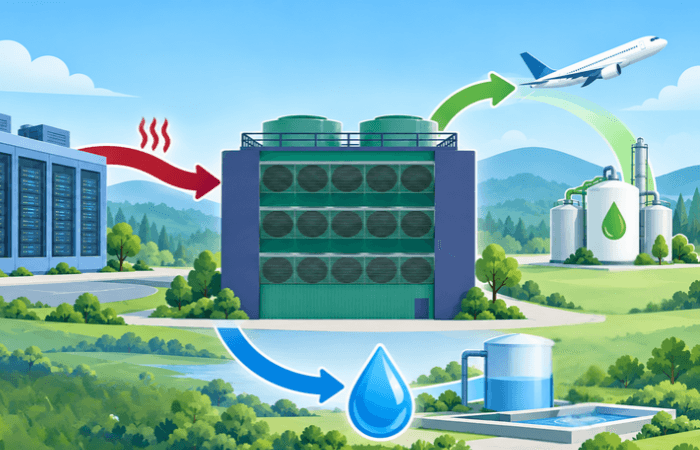
By co-locating carbon capture technology with data centres, DAC creates three complementary circular uses that improve energy efficiency, recover water and provide a sustainable source of carbon dioxide for industrial use. Altogether, this opens up new commercial opportunities while supporting the transition to a low-carbon, resource-efficient economy.
[1] Circular Heat: Reusing Data Centre Waste Heat to Power Carbon Capture
Data centres generate substantial amounts of heat through their IT equipment and cooling systems. Traditionally, much of this heat has been discharged into the environment. However, it offers energy that can be recovered and reused.
Certain DAC technologies, such as NEG8 Carbon’s, use a low-temperature regeneration process, allowing heat from data centres to provide the thermal energy required to release captured CO₂ from the sorbent material. This lowers the energy cost of carbon capture.
Depending on operating conditions and system integration, heat reuse could reduce the dedicated DAC energy input by about 70% per tonne of CO₂ captured (this figure is based off metrics from the NEG8 Carbon DAC system).
This approach also aligns with the EU Energy Efficiency Directive (Directive 2023/1791) Article 26(6), which requires Member States to ensure that data centres with a total rated energy input exceeding 1 MW use waste heat or other heat recovery applications, unless not technically or economically feasible. DAC provides a route for reusing heat beyond the conventional district heating option. (See: EU Energy Efficiency Directive: Data Centre Waste Heat Powering DAC)
Furthermore, integrating DAC with data centre cooling systems provides complementary cooling. This approach reduces the energy needed for conventional cooling equipment.
In this way, one industry’s waste heat becomes another process’s energy source, creating an industrial symbiosis model that benefits both operations.
[2] Circular Water: Recovering Water from the Atmosphere
Alongside capturing CO₂, certain DAC technologies (such as NEG8 Carbon’s DAC) produce pure water as a by-product. In the case of NEG8 Carbon’s DAC system, approximately two tonnes of water can be produced for every tonne of CO₂ captured, depending on atmospheric conditions and operating parameters.
This water can be used in data centre operations or supplied for suitable industrial and community uses.
[3] Circular Carbon Dioxide: Turning Atmospheric CO₂ into eFuels
The third resource loop is reusing the captured CO₂. This gives industries the opportunity to use captured CO₂ as a feedstock, instead of fossil-derived CO₂ , for products such as eFuels, chemicals and other industrially manufactured materials.
With eFuels, including synthetic sustainable aviation fuel (eSAF), DAC-captured CO₂ is combined with renewable hydrogen, allowing fuel manufacturers to produce synthetic hydrocarbons without extracting new fossil carbon.
When these fuels are used, the CO₂ is released back into the atmosphere. However, because the carbon originally came from the air, the process forms part of a circular carbon cycle. Its full climate benefit depends on renewable energy use, production emissions and lifecycle performance.
Under the EU’s ReFuelEU Aviation Regulation, sustainable aviation fuel must account for at least 6% of aviation fuel supplied at EU airports by 2030 with the synthetic/electro aviation fuel (eSAF) requirement of that 6% averaging 1.2% over 2030 and 2031, with the minimum share increasing in subsequent years.
These requirements create demand for non-fossil carbon feedstocks and DAC can help meet this demand.
Conclusion
Integrating DAC with data centres addresses two connected challenges: improving the sustainability of data centres and developing a source of carbon for synthetic fuel production, which enables data centres to actively participate in the circular economy.
Sources
- Government of Ireland: Whole-of-Government Circular Economy Strategy 2026–2028
- European Union: Energy Efficiency Directive (EU) 2023/1791
- European Commission: ReFuelEU Aviation
- European Commission: 2026 EU ETS Legislative Proposal
- European Union: Carbon Removals Certification Framework
- Nature Chemical Engineering: Water Management and Heat Integration in Direct Air Capture Systems
- Carbon Capture Science & Technology (2026): In-depth Direct Air Capture Integration to Achieve Zero-carbon and Water Data Center