
NEG8 Carbon’s Direct Air Capture Technology Drives Down Costs per Tonne of CO2 Captured
20 November 2026
A Paradigm Shift in Improving Energy Efficiency and Reducing Costs of DAC
In Direct Air Capture (DAC), the energy required to capture and release CO₂ has a major effect on the cost of the process. Improving energy efficiency, extending sorbent lifespan and reducing operational costs are the top priorities in making DAC commercially viable.
NEG8 Carbon has developed Electrostatic Direct Air Capture technology that addresses these challenges.
This high performing technology delivers efficient heat transfer during the DAC process which allows the sorbent to be heated and cooled more rapidly, reducing the energy and time required for each regeneration cycle. It also stresses the sorbent less, and consequently, the sorbent endures thousands of cycles with minimal degradation and a long lifespan which saves costs. Furthermore, the performance of the electrostatic technology has been validated through thousands of cycles and 18 months testing at pilot scale at time of posting.
This is a major advancement over typical rigid adsorbent structures where repeated cycling causes physical and chemical degradation of the sorbent over time.
NEG8 Carbon’s Electrostatic DAC Technology Delivers Superior Performance Compared to Conventional DAC Systems
Conventional solid sorbent DAC systems use a variety of methods to hold sorbent materials in place and transfer heat during capture and regeneration. These include packed beds containing sorbent particles and structured systems where sorbents are attached to supporting surfaces using chemical binders. The method used to support and heat the sorbent affects energy consumption and operating costs.
NEG8 Carbon’s electrostatic technology eliminates the need for chemical binders while the sorbent layer remains in direct contact with the heat exchanger.
| Category | Packed Beds | Chemical Adhesives / Binders | NEG8 Carbon’s Electrostatic Technology | Customer Value |
| Sorbent Accessibility | High energy cost to drive air through a packed bed of sorbent | Binders block the sorbent pores, reducing the “breathing” capacity. | No binders used and 100% of the sorbent’s surface area remains exposed and active. Less energy required to bring the CO2 in contact with the sorbent | Higher efficiency: Less sorbent, higher carbon capture rate |
| Heat Transfer | Heat must be transferred through the packed material, resulting in temperature gradients and slower heating or cooling. | Energy wasted in heating binders that have no carbon capture function | Direct thermal contact: eliminating the binder removes thermal resistance, allowing rapid heating of the active capture site | Rapid regeneration and energy savings: dramatically slashes the cycle time and the utility costs required to heat or cool the sorbent bed. |
| Mechanical Stress | Repeated thermal cycling and particle expansion/contraction causes sorbent attrition. | Thermal stress: binders crack and delaminate when the device heats and cools. | Flexible adhesion: the electrostatic field allows the sorbent to expand/contract freely without breaking the adhesion. | Longer lifespan: with ‘breathable’ sorbent technology. |
| Sorbent Replacement | Sorbent particles can be removed and replaced. | Permanent/damage: removing a bound sorbent requires harsh solvents, or replacement of the whole structure. | Smart release: Neutralising or shifting the charge allows the layer to slide off cleanly. | Lower maintenance costs: rapid sorbent replacement with no heat exchanger damage. |
Lightweight Heat Exchanger: Reducing Energy Consumption
NEG8 Carbon has developed a lightweight heat exchanger with low thermal mass.
Thermal mass determines how much energy is required to change the temperature of a component. A heat exchanger with high thermal mass requires more energy to heat up and cool down during each DAC cycle. By reducing the thermal mass of a heat exchanger, less energy is needed for temperature changes, and therefore shorter cycle times and lower operating costs.
The system also operates at a low regeneration temperature of approximately 65°C. This reduces energy costs as well as reducing sorbent stress thus extending its lifespan.
Furthermore, the low regeneration temperature allows for heat reuse from industrial processes and data centres, reducing the demand for additional energy.
Indirect Heating and CO₂ Purity
NEG8 Carbon’s heat exchanger uses indirect heating during sorbent regeneration to transfer thermal energy to the sorbent.
In systems that use steam or other gases in direct contact with the sorbent, the released CO₂ is mixed with water vapour or other process gases. Additional separation or drying steps are needed to achieve the required CO₂ purity. NEG8 Carbon’s approach also reduces material stress and degradation from moisture and temperature changes resulting from direct contact with steam.
Therefore, using indirect heating lowers downstream processing requirements while providing longer sorbent life.
Lower OPEX through Increased Energy Efficiency and Longer Sorbent Lifespan
Energy consumption, sorbent durability and maintenance requirements all influence the cost of each tonne of CO₂ captured. NEG8 Carbon tackles these by combining its electrostatic technology with its unique lightweight heat exchanger. For DAC deployment at commercial scale, NEG8 Carbon’s DAC technology lowers cost per tonne of CO₂ captured.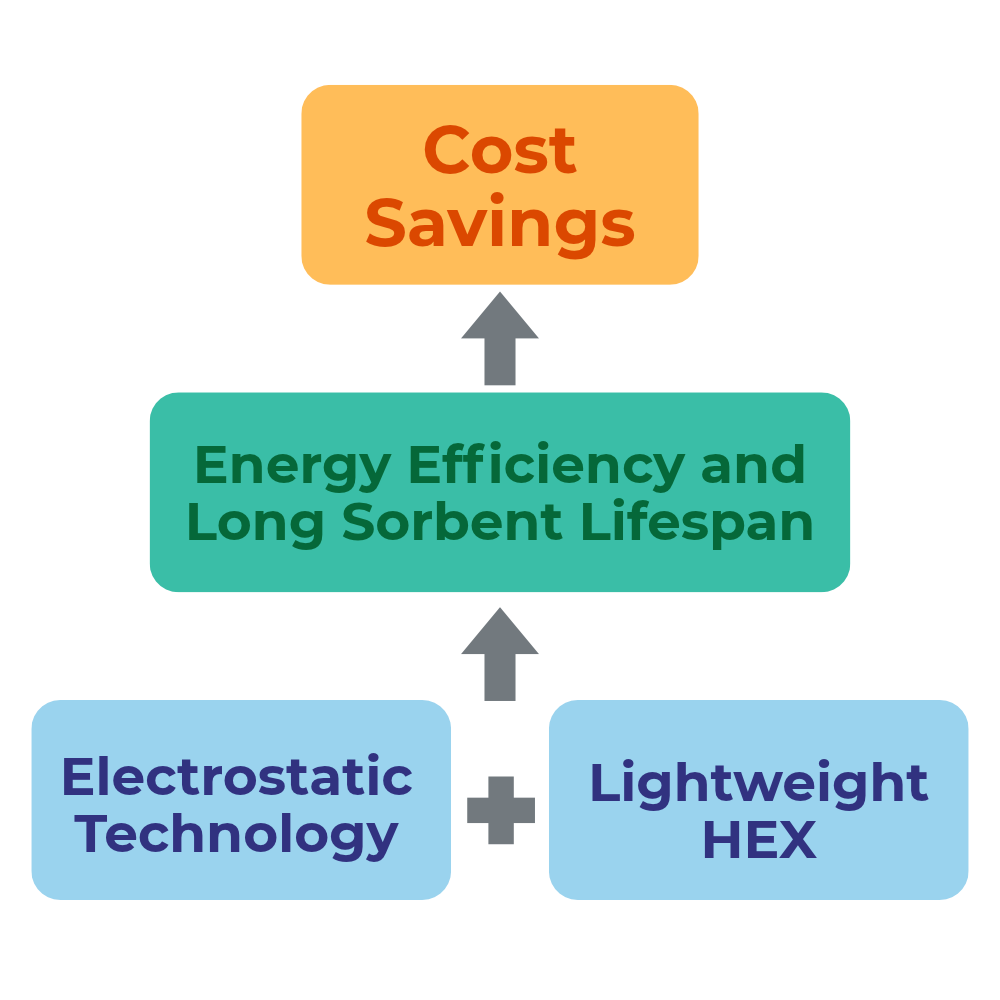
For more: