
Decarbonise Industry and Support Net-Zero with Direct Air Capture
27 April 2026
Industrial decarbonisation is not just a long-term climate goal. It is now a business requirement for industries with high emissions and energy use, and companies that supply carbon-intensive materials.
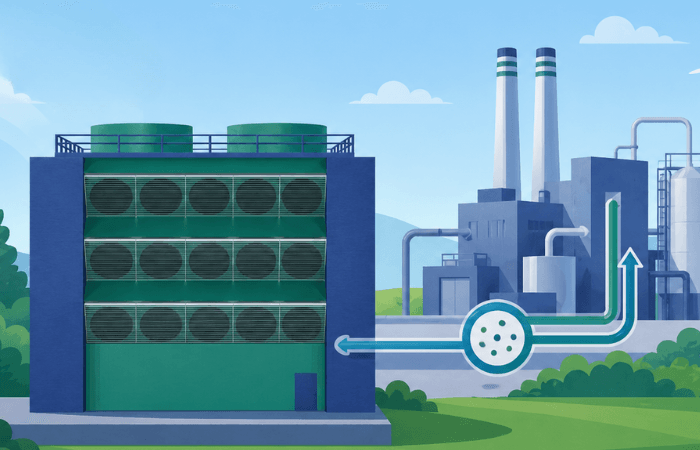
Direct Air Capture (DAC) can support industrial decarbonisation of these industries and help them with the drive towards net-zero industry emissions by using industrial waste heat to power DAC that captures carbon dioxide (CO₂) and provides CO₂ as a feedstock.
Pressure to Achieve Net-Zero Emissions
In the EU, the European Climate Law sets a legally binding target of net-zero greenhouse gas emissions by 2050, with a 2030 target of at least 55% net greenhouse gas emissions reduction compared with 1990 levels.
For industry, emissions now carry a direct cost. The EU Emissions Trading System, the Industrial Emissions Directive and the Carbon Border Adjustment Mechanism all place pressure on companies to reduce CO₂ emissions, improve process efficiency and lower the carbon intensity of their products.
The revised Industrial Emissions Directive also brings stricter emission limit values, stronger permitting rules and fines of at least 3% of annual EU turnover for the worst breaches, as set out by the European Commission.
At the same time, the Carbon Border Adjustment Mechanism applies a carbon price to selected carbon-intensive imports, including cement, iron and steel, aluminium, fertilisers, electricity and hydrogen. This is designed to make the carbon price of imports equivalent to the carbon price faced by EU producers.
What Industry Needs to Decarbonise
Heavy industry needs decarbonisation methods that can work with real industrial conditions. Cement, steel, chemicals, plastics, and refining cannot rely on one solution alone. Energy efficiency, electrification, renewable power, low-carbon hydrogen, process redesign and carbon capture will all have roles to play.
However, some emissions are difficult to remove at source. These include process emissions from cement, chemical feedstock emissions and emissions linked to high-temperature heat. This is where Direct Air Capture (DAC) can support net zero industry.
How Direct Air Capture Helps Net-Zero Industry
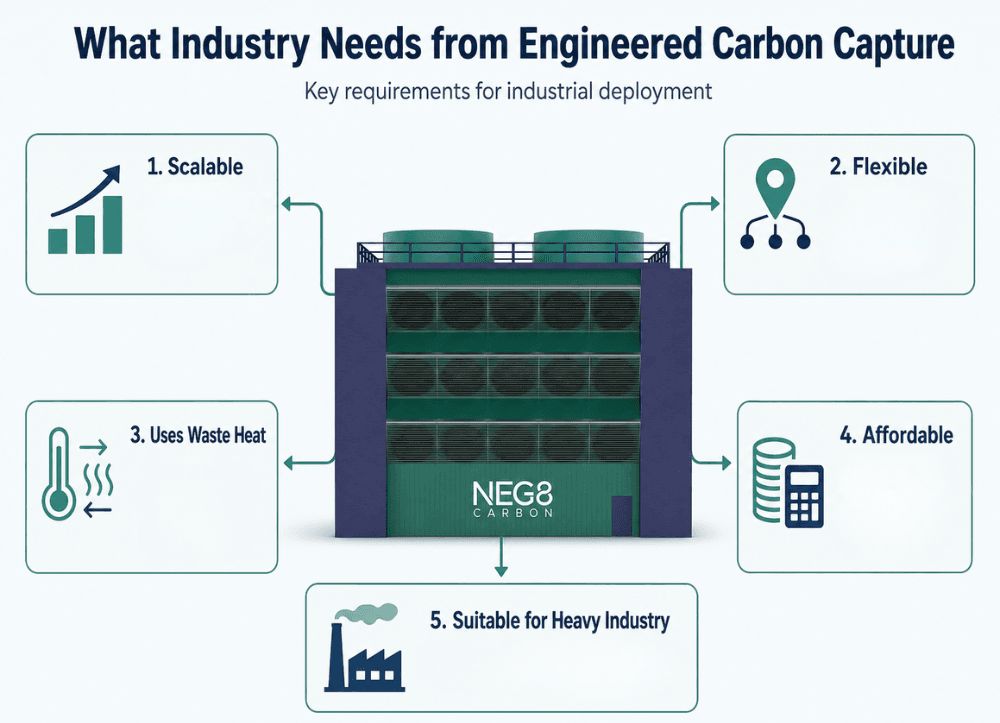
Industry needs engineered carbon capture solutions that are:
- Scalable – The technology can grow from pilot units to larger industrial systems.
- Flexible – The technology can be located near industrial sites, CO₂ users or storage routes.
- Able to use waste heat – Energy demand and operating cost can be reduced.
- Affordable enough to deploy – Especially in sectors with tight margins.
- Suitable for heavy industry – Where CO₂ emissions are hard to abate.
Direct Air Capture removes CO₂ directly from ambient air (See: How does Direct Air Capture Work?). The captured CO₂ can then be stored permanently or used as a feedstock. The International Energy Agency states that DAC can help balance emissions that are difficult to avoid, including from heavy industry and long-distance transport. It also notes that air-captured CO₂ can be used as a climate-neutral feedstock for products that need a carbon source.
This makes DAC different from point-source capture. Point-source capture removes CO₂ from flue gas at a factory or power plant (See: Direct Air Capture vs Point Source). DAC removes CO₂ from the air, so it can be placed where low-carbon energy, waste heat, storage infrastructure or CO₂ users are available. This siting flexibility is one of DAC’s main advantages.
The Importance of Waste Heat to Direct Air Capture Efficiency
One of the main challenges for DAC is energy demand. Capturing CO₂ from air is more energy intensive than capturing it from a concentrated industrial exhaust stream because CO₂ is much more dilute in the atmosphere. For that reason, the cost and source of energy are major design factors.
Considering this, industrial waste heat becomes valuable, especially in the light of 20% to 50% of industrial energy currently being lost as waste heat. In NEG8 Carbon’s case, DAC units use 71% less energy when waste heat is used compared with not using it. (See: Direct Air Capture Using Waste Heat).
For industrial sites, this is a strong fit. Heat that would otherwise be rejected can be used to help regenerate the DAC process. This can reduce the energy input needed for CO₂ capture and can improve the business case for deployment beside factories, data centres, cement plants, chemical plants and eFuel production sites.
DAC Supplying CO₂ as an Industrial Feedstock
Captured CO₂ can be stored but it can also be used in products and processes that need carbon. New opportunities are emerging that include CO₂-based synthetic fuels, chemicals and building aggregates.
This is particularly relevant for industries such as chemicals, plastics and methanol. CO₂ can be converted into chemical intermediates, including methanol, and methanol can then be converted into other carbon-containing products.
This makes DAC useful for carbon circularity. Instead of relying only on fossil carbon as a feedstock, manufacturers can use captured atmospheric CO₂ where the process, economics and product standards allow it.
A Practical Route for Heavy Industry to Decarbonise
For heavy industry, DAC should not be seen as a replacement for emissions reduction at source. The first priority should still be to reduce avoidable emissions through efficiency, electrification, renewable energy, low-carbon fuels and better process control.
However, DAC can support the part of the problem that remains. It can help address residual emissions while providing a supply of CO₂ for industrial use.
Carbon Emissions by Industry
Several industrial sectors dominate global CO₂ emissions due to high energy demand and process-related emissions. The most notable contributors are cement, steel, chemicals, refining, and metals such as aluminium. These sectors are energy-intensive and rely heavily on fossil fuels, while some also release CO₂ directly through chemical reactions during production.
| Industry Sector | Approx. Annual Emissions (Gt CO₂ / year) | Notes |
|---|---|---|
| Cement & Concrete | ~2.6–3.0 Gt CO₂ | ~7–8% of global emissions; process emissions from limestone calcination. (UNECE) |
| Iron & Steel | ~3.6 Gt CO₂ | One of the largest single industrial emitters; ~7–9% of global emissions. (Global Efficiency Intelligence) |
| Chemical Manufacturing incl. petrochemicals | ~0.9–1.0 Gt CO₂ | Includes ammonia, methanol, plastics; ~15% of industrial emissions. (IEA) |
| Oil Refineries | ~1.2–1.5 Gt CO₂ | High emissions from fuel processing and heat demand. |
| Aluminium: Primary + Secondary | ~0.6–0.7 Gt CO₂ | ~2–3% of global emissions; highly electricity intensive. (Global Efficiency Intelligence) |
| Pulp & Paper | ~0.6 Gt CO₂ | Mix of fossil and biogenic emissions; significant heat demand. |
| Glass & Ceramics | ~0.3–0.4 Gt CO₂ | High-temperature kiln processes. |
| Non-ferrous Metals: Other | ~0.2–0.3 Gt CO₂ | Includes copper, zinc and other non-ferrous metals. |
| Food & Beverage Processing | ~0.3–0.5 Gt CO₂ | Fuel combustion and process heat. |
Conclusion
Industrial decarbonisation will require more than one technology. Heavy industry needs systems that can reduce emissions at source, use energy more efficiently and manage residual CO₂. Direct Air Capture can help meet this need because it removes CO₂ from ambient air, can be placed near industrial sites, and can supply captured CO₂ for storage or use. As industry moves towards net zero, DAC can help manufacturers reduce exposure to carbon costs, use waste heat more effectively and create new value from captured CO₂.
For more:
- Hydrogen Electrolysers Co-Located with Direct Air Capture for eFuel Production
- Sustainable Data Centres with Direct Air Capture
- Decarbonisation