
Direct Air Capture in Arid Regions
8 January 2026
By Prof. Don MacElroy (Professor Emeritus in Chemical Engineering, University College Dublin, and Chairman of the NEG8 Carbon Advisory Board) and Jeannie De Vynck
Carbon Dioxide Removal and Water Harvesting
As the Gulf states grapple with high carbon emissions alongside chronic water scarcity, Direct Air Capture (DAC) is emerging as uniquely suited to address both challenges while benefiting from the abundant solar resources of the region for renewable energy to power the DAC process.
(Useful reading: What is Direct Air Capture? and How does Direct Air Capture Work?)
Current CO2 emissions from fuel combustion processes vary considerably across the Middle East and North Africa (MENA) region as shown in the table below (2023 figures).
Table 1. Carbon dioxide emissions from combustion in the MENA region
| Country | aPer capita tCO2 emissions (total emissions, MtCO2) |
| Qatar | 31.9(95) |
| Bahrain | 22.9(36) |
| Kuwait | 21.1(102) |
| UAE | 17.4(184) |
| Saudi Arabia | 16.1(535) |
| Oman | 15.3(78) |
| Iran | 8.0(727) |
| Libya | 6.6(48) |
| Israel | 6.1(56.4) |
| Iraq | 4.1(186) |
| Algeria | 3.37(155) |
| Tunisia | 2.17(25.4) |
| Jordan | 2.11(24) |
| Egypt | 2.1(242) |
| Lebanon | 2.0(11.6) |
| Morocco | 1.72(65.4) |
| Syria | 1.04(25) |
| Palestine | 0.765(4.13) |
| Yemen | 0.372(14.5) |
ahttps://www.iea.org/emissions (Fuel combustion 2023). 2023 per capita emissions for Ireland = 5.8
The top six countries: Qatar, Bahrain, Kuwait, the UAE, Saudi Arabia and Oman (the Gulf states) are also the highest income and net exporters of oil and gas in the MENA region. Furthermore, it is clear on a per capita basis that these six countries are strong candidates for deployment of process technologies involving carbon dioxide capture and related commercial and societal needs.
These regions are under pressure to find carbon dioxide removal (CDR) approaches that work in harsh climatic conditions, i.e. they need to operate reliably under high ambient temperatures and low-to-moderate relative humidity.
Within this context, Direct Air Capture stands out as an engineered carbon removal option that can be deployed at any location, independently of point sources, with designs adaptable to this climate.
Why DAC is Suitable for the Arid Regions of the Middle East
Direct Air Capture is well suited to deployment in arid areas due to a combination of environmental and infrastructural factors.
DAC is powered by renewable and low-carbon energy
Arid regions have an abundance of solar power opportunities considering the high levels of solar irradiance, the many days of sunlight per year and the open land available. For example, Abu Dhabi experiences an average of 3457 hours of sunshine annually.
DAC can be deployed in areas of sparsely populated land
In arid regions, sizable uninhabited areas allow for scaled-up DAC deployment with only a limited impact on surrounding communities.
Established energy infrastructure in the Middle East
The strong industrial capability in these regions provide a foundation for construction, operation, and maintenance of carbon capture facilities.
The effects of temperature and humidity on DAC
However, before embarking on DAC deployment in the arid or near-arid regions typical of the six Gulf states, a number of issues must be taken into consideration. While, in view of atmospheric mixing via air currents and trade winds, the level of carbon dioxide in the atmosphere may be considered to be relatively uniform globally at 430 ppm (2025 observations), the efficiency of any given DAC technology depends to a significant extent on the local environment within which it is deployed. DAC in arid regions can encounter a number of very challenging limitations, the two most important of which are local temperature variations (the primary target for discussion here is solid sorbent DAC) and atmospheric humidity (with the possibility of process additionality involving water harvesting).
By definition, arid regions are those land areas subject to extreme temperature fluctuations with large diurnal (daytime highs and nighttime lows) and seasonal variations and, importantly, by low absolute and relative humidity.
Meteorological observations from selected locations in Gulf states Qatar (Doha), Bahrain (Manama), Kuwait (Kuwait City), UAE (Abu Dhabi), Saudi Arabia (Jeddah and Riyadh), and Oman (Muscat) and at different times of the year and day have been examined. With the exception of Riyadh, the studies primarily refer to coastal locations for which information is widely available. However in common with the low humidity levels observed for Riyadh, in the inland desert areas of the Gulf states atmospheric moisture levels are generally very low throughout the year.
Temperatures in mid-summer typically display midday maxima in the range 40 – 50°C. With clear night skies, the nighttime summer temperatures drop to around 30°C, while in inland desert regions the surface rapidly cools with minima sometimes reaching 0°C or lower. Winter temperatures are moderate with daytime averages ~ 20°C dropping to 10-15°C at night.
The meteorological observations for the six Gulf states also demonstrate that relative humidity as well as temperature are highly variable depending significantly on location, time of year and time of day and as pointed out above this has significant implications for solid sorbent DAC. To assess this, CO2 and H2O sorption equilibria for a widely studied sorbent, LewatitTM VP OC 1065 (see for example R. Venemans et al, Int J Greenhouse Gas Control, 41, 268-275 (2015)), have been computed for each of the seven Gulf locations mentioned above during the summer and winter months and during daytime and nighttime hours and the results are graphically represented in Figure 1 (CO2 adsorption) and in Figure 2 where the relative equilibrium loadings of water and CO2 are shown.
In summary:
- For solid sorbent DAC which normally operates under ambient conditions during the adsorption phase of the process, temperature has a very significant effect on the CO2 sorption equilibria. Also, since air humidity can positively influence CO2 uptake and capture, it is clear that careful studies of the ambient conditions are major prerequisites in the specification of the DAC system operating conditions appropriate to the location in which it is to be deployed.
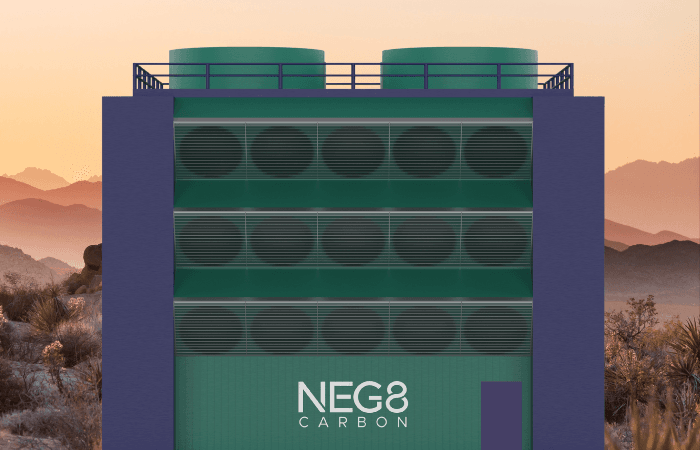
- Unlike most other DAC systems in current development, one of the important attributes of the NEG8 DAC system design is that it does not require water for its operation. Furthermore, a positive characteristic of this DAC system is that it can harvest moisture directly from the atmosphere. The potential for this aspect of the DAC process is clearly indicated in the results provided for the relative magnitudes of the mass of water and CO2 adsorbed under equilibrium conditions (illustrated in Figure 2). This implies that the level of water harvested is surprisingly less dependent on temperature and humidity and this has been confirmed by work conducted at the NEG8 Carbon facility in Waterford. (Note that the sharp peak shown in the data in Figure 2 at 32oC and relative humidity 80% are reported conditions for Abu Dhabi during nighttime in the summer months).
- In this regard it is also noted that the NEG8 Carbon DAC system will employ AI predictive control through continual on-site ambient measurements which mitigates significant deviations during process operations.
Ambient Air Water Harvesting is a Valuable By-product of DAC
Water consumption impacts the economy and growth within the MENA region. In the Gulf states for example water usage (M. Abdelraouf, Water Issues in GCC Countries: Status, Challenges, and Solutions (2024)) is approximately distributed between agriculture (77%), industry (18%) and domestic consumption (5%). As indicated in Figure 2, water harvesting can be a secondary output of Direct Air Capture. This happens when water is released during the CO2 capture and regeneration process, as is the case for NEG8 Carbon’s technology where, typically, 1-2 tonnes of water are produced for every one tonne of CO₂ captured. This is particularly relevant in water-scarce areas where water sources are limited and demand continues to rise. For the six Gulf states of the Middle East cited above, the total CO2 emissions (for 2023) came to 1030 Mt. In light of the potential to capture water during operation of the NEG8 DAC system (with the potential for higher levels of water capture indicated for the UAE during nighttime in the summer months), this implies that between 1 and 2 billion tonnes of water could be harvested. Currently water consumption in the six Gulf States per capita is approximately 0.55 m3 per day (M. Abdelraouf (2024)) or in excess of 12.3 Billion tonnes per annum. Water harvesting through NEG8 Carbon’s DAC systems could therefore represent as much as 8-16% of the water requirements for this region.

Figure 1. Equilibria for Adsorbed CO2 as predicted by correlations reported by Venemans et al. (2015) for the Gulf states at different times of the day during the summer and winter months.

Figure 2. Relative magnitude of the equilibrium mass loadings of water and CO2 adsorbed from humid air as predicted by correlations reported by Venemans et al. (2015) for the Gulf states at different times of the day during the summer and winter months.
Potential uses of water produced by DAC
- Industrial process water
- Cooling and cleaning for energy infrastructure
- Water for agriculture
- Potable water (as a replacement for water currently produced from desalination plants)
Other environmental and social benefits of DAC in dry areas include
- Minimal land disturbance compared to nature-based solutions
- No competition with food or freshwater resources
- Contribution to climate mitigation without reliance on offsets alone
Final Thoughts
Direct Air Capture is well suited to hot and arid regions due to its ability to operate under harsh climatic conditions while also remaining independent of point source emissions. The comments provided in this article are not restricted to the six Gulf states as highlighted in the above but will also apply to other areas across the MENA region. When deployed at scale, DAC offers combined benefits through permanently removing carbon, producing pure water, and providing captured CO₂ for chemical feedstock manufacturing (for example methanol/eFuel production). Direct Air Capture delivers for climate action, energy security, and long-term economic planning in regions facing both emissions pressure and resource constraints.