
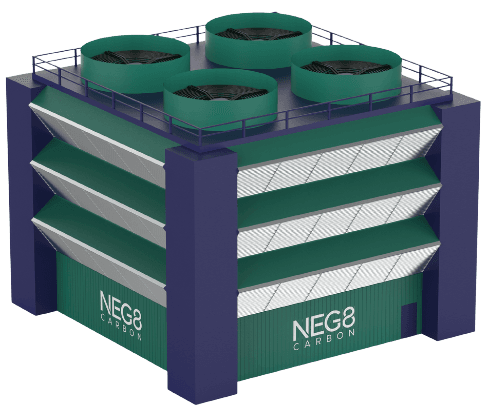
How NEG8 Carbon's Electrostatic DAC Technology Works
Direct Air Capture is a technology that removes carbon dioxide (CO₂) from the air. In the NEG8 Carbon solution, atmospheric air is drawn into the unit by large fans and is passed over a specifically designed sorbent that attracts and captures CO₂ molecules.
We use our patent published Electrostatic DAC technology to create stable, thin, active layers of sorbents on highly sensitive surfaces.
When the sorbent is heated, the concentrated CO₂ is released. The captured CO₂ can then be permanently and safely stored underground or used in climate-neutral carbon products, such as Sustainable Aviation Fuel (SAF) and sustainable concrete.
(Learn more: How Does Direct Air Capture Work?)
Our DAC technology is based on modular, scalable ‘plug-and-play’ units that operate at low OPEX costs due to industrial waste heat being used to power the DAC process.
Unique Advantages of NEG8 Carbon's DAC Technology
Carbon Capture Innovations
NEG8 Carbon is continuously pursuing technological advancement to bring down energy, process and manufacturing costs to make DAC widely accessible.
Advanced Sorbent Deployment
NEG8 Carbon has developed a novel way of deploying sorbents, the material used for capturing the CO₂.
It uses a revolutionary method for fixing and releasing the sorbent in a thin layer to a heat exchanger.
Benefits:
- Faster CO₂ capture and release
- Low volume of sorbent
- Ease of loading/ unloading sorbent to/ from the heat exchanger
Enhanced Heat
Exchange Process
This technology dramatically improves the heat exchange process within the DAC system. It optimises heat transfer to the sorbent material, enabling faster heat transfer, improving the efficiency of the sorbent’s regeneration process and increasing the rate of CO₂ capture.
Benefits:
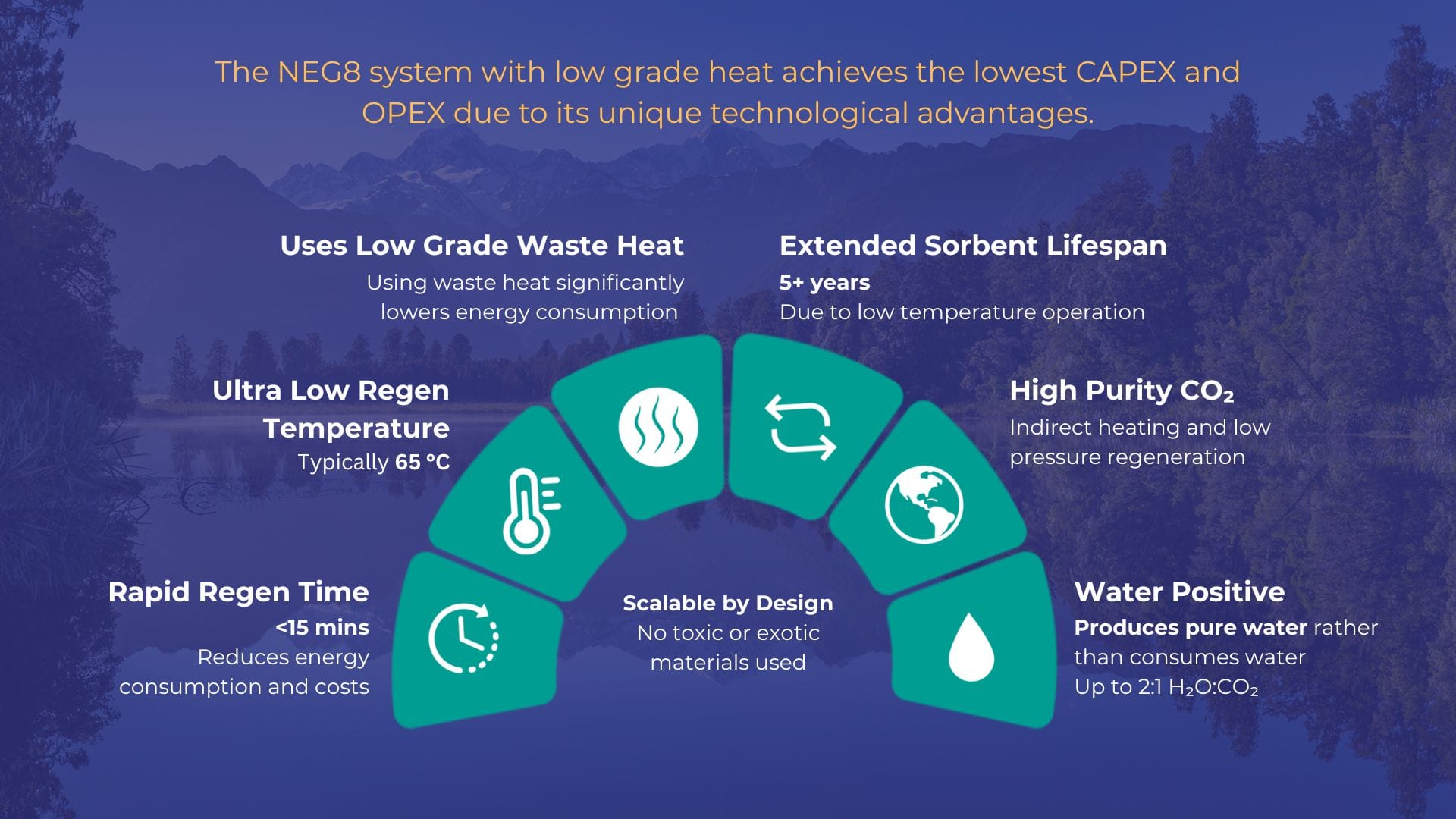
- Rapid regeneration time (10 minutes)
- Low regeneration temperature
- Dramatic increase in CO₂ capture rate
- Highly energy efficient
Additional Benefits of NEG8's Technology

Water Harvesting
NEG8’s technology produces pure water as a by-product of the carbon capture process.
This further enhances operational sustainability, particularly if the Direct Air Capture units are operating in arid, water-scarce regions.

Cooling
The NEG8 DAC process offers the additional benefit of cooling. For example, if a DAC system is co-located with a data centre, the NEG8 DAC installation can provide the double environmental benefit of both carbon capture and zonal cooling in one system. See: Direct Air Capture and Data Centres Working Together

Energy Efficiency and Waste Heat Input
The NEG8 Carbon DAC system requires less energy than conventional DAC solutions, making it more cost-effective and environmentally friendly. Innovations reduce power usage by using less sorbent and lowering the temperature needed for CO₂ extraction, which also extends the lifespan of the sorbent.The NEG8 DAC process is unique as it requires only a low temperature heat of ~65 °C for sorbent regeneration. This makes it an excellent fit for low grade heat recovery from industrial operations.

Sequestration and Utilisation
To minimise CO₂ transport emissions, cost and risks, DAC units should be located at the site of utilisation. Alternatively, the captured CO₂ can be stored safely in depleted oil wells or other certified storage areas.
Moreover, DAC sites can be powered by off-grid low-carbon energy which means they do not interfere with the local community’s power supplies.
Learn more about:
Carbon Sequestration and Carbon Utilisation
DAC CO₂ in Concrete | DAC CO₂ in e-SAF
How DAC Technology Works
People Often Ask
What is Direct Air Capture?
Direct Air Capture is a technology that uses molecular technology to extract carbon dioxide (CO₂) from the air to fight climate change caused by CO₂ emissions.
More About Direct Air Capture
How Does Direct Air Capture Work?
Direct Air Capture technology works by drawing in large quantities of air and passing it over specifically designed nano materials that attract and capture carbon dioxide molecules.
More About How Direct Air Capture Works
What Happens to the Captured CO₂?
The captured CO₂ can be permanently and safely stored underground using geological mineralisation or in depleted oil and gas wells. Another option is to use the CO₂ in making climate-neutral carbon products, such as sustainable aviation fuel (SAF), contributing to a cleaner, greener future.
More About Carbon Sequestration and Carbon Utilization
Difference Between Direct Air Capture & Point Source Carbon Capture
Direct Air Capture removes the already emitted CO₂ in the atmosphere at any location in the world, while point source carbon capture takes place at the point of emission, such as a power station. There are distinct differences in their roles and benefits. Find out more:
More About Direct Air Capture vs Point Source