
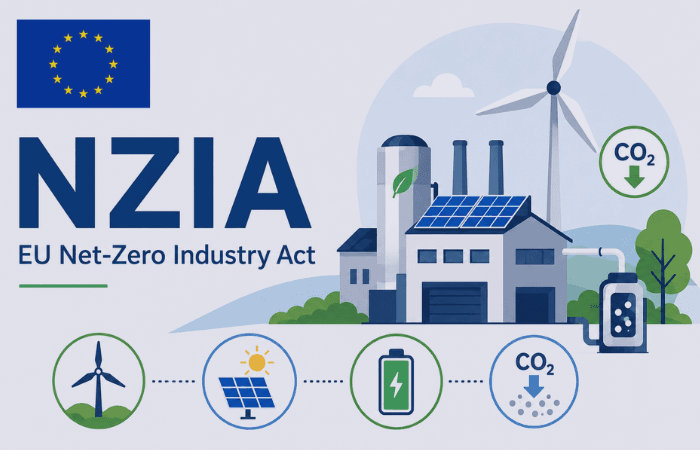
The EU Net Zero Industry Act (NZIA)
19 August 2026
What the NZIA Means for Industry, Climate Policy and Direct Air Capture
What is the Net-Zero Industry Act?
The Net-Zero Industry Act (NZIA) is one of the European Union’s main industrial policies for building domestic capacity to make the technologies needed for decarbonisation.
In more formal language, its official title is “Regulation (EU) 2024/1735 on establishing a framework of measures for strengthening Europe’s net-zero technology manufacturing ecosystem”.
Rather than setting another emissions limit on companies, the NZIA focuses mainly on the supply side of the net-zero economy. It is intended to:
- Increase European manufacturing capacity
- Shorten permitting periods
- Support strategic projects
- Reduce dependence on imported clean technologies
Furthermore, it supports the EU’s legally binding targets to reduce net greenhouse gas emissions by at least 55% by 2030 and by 90% by 2040 (compared with 1990) and achieve climate neutrality by 2050.
A priority objective is for every individual product or project to contain at least 40% European content by 2030. The Regulation also aims to increase the EU’s share of global net-zero technology production towards 15% by 2040.
NZIA is an EU Regulation, rather than a Directive. It therefore applies directly across the 27 EU Member States, although Member States remain responsible for areas such as permitting authorities, enforcement arrangements and certain penalties.
Why the Net-Zero Industry Act was Implemented?
The NZIA was developed as part of the EU’s Green Deal Industrial Plan. A major concern behind the Act was that Europe had set large renewable energy and decarbonisation targets while remaining dependent on imports for many of the technologies needed to achieve them.
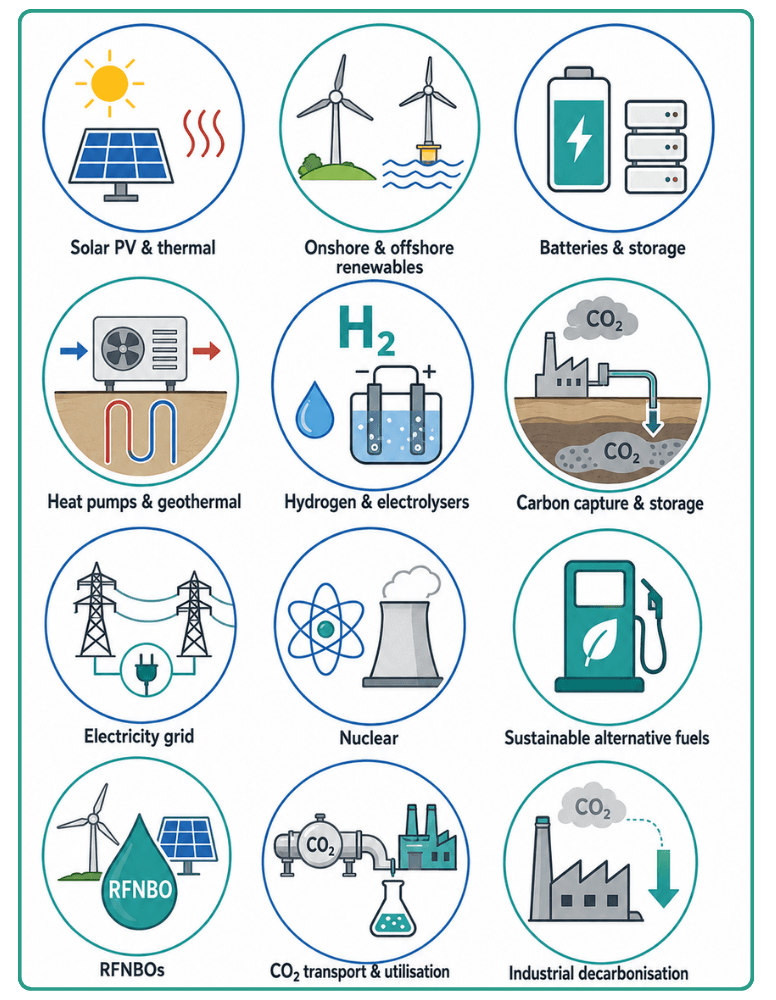
NZIA therefore seeks to increase manufacturing within the EU for technologies including:
- Solar photovoltaic and solar thermal technologies
- Onshore and offshore renewable technologies
- Batteries and energy storage
- Heat pumps and geothermal technologies
- Hydrogen technologies and electrolysers
- Carbon capture and storage
- Electricity grid technologies
- Nuclear technologies
- Sustainable alternative fuels
- Renewable fuels of non-biological origin
- CO₂ transport and utilisation technologies
- Industrial decarbonisation technologies
Direct Air Capture is recognised within the carbon capture technology category in subsequent NZIA legislation.
How the NZIA Works
The NZIA uses several mechanisms rather than relying on one subsidy or emissions requirement.
Faster Permitting
Net-zero manufacturing projects have defined permit deadlines, generally 12 or 18 months depending on capacity while Net-Zero Strategic Projects receive priority treatment.
Public Procurement
Public authorities may need to consider more than price when purchasing net-zero technologies with other criteria such as environmental sustainability and supply resilience being considered.
Renewable Energy Auctions
Member States must apply NZIA non-price criteria to at least 30% of annual renewable energy auction volumes, subject to the Regulation’s alternative 6 GW threshold. Developers may therefore need to consider equipment origin, supply-chain security along with environmental performance.
NZIA’s Impact on Industries
| Industry | Expected NZIA Impact |
| Solar and wind | Greater support for EU manufacturing. Supply-chain origin and sustainability will have more influence in public procurement and renewable auctions. |
| Battery and energy storage | Increased support for European manufacturing capacity and reduced dependence on concentrated overseas supply chains. |
| Hydrogen and electrolysers | Manufacturing projects can benefit from NZIA permitting rules and strategic-project status. |
| Electricity grids | Grid equipment is recognised as net-zero technology, supporting investment in manufacturing capacity required for electrification. |
| Heat pumps and geothermal | European manufacturing capacity is supported as deployment rises under EU energy policy. |
| Steel, cement and chemicals | Certain energy-intensive industry projects can fall within NZIA where facilities manufacture components used by net-zero technologies or make qualifying decarbonisation investments. |
| Oil and gas | Certain producers have direct legal obligations to contribute towards EU CO₂ injection capacity. |
| CCS and CO₂ infrastructure | CO₂ capture and storage technologies receive explicit recognition, while storage development is backed by a separate 2030 capacity obligation. |
| Direct Air Capture | DAC technology is expressly included within the NZIA framework and can benefit from manufacturing, strategic-project and CO₂ infrastructure measures. |
| Alternative fuels and RFNBOs | Technologies for sustainable fuels and renewable fuels of non-biological origin fall within the scope of NZIA. |
Manufacturing equipment, industrial infrastructure, CO₂ management and clean fuel production are all covered to some degree.
Penalties Under the NZIA
An important distinction to other regulations like the EU ETS is that NZIA does not establish one standard EU-wide monetary penalty for companies.
Its clearest provision relates to the obligation placed on certain oil and gas producers to contribute towards the EU’s CO₂ storage target. Under Article 23, Member States were required by 30 June 2026 to establish penalties for infringements of these obligations. The Regulation requires them to be effective, proportionate and dissuasive but does not prescribe one fixed euro-per-tonne penalty across the EU. It is therefore not another carbon tax/fine.
Carbon Capture, CO₂ Storage and the NZIA
Carbon capture has a direct role within NZIA. The Regulation sets an EU objective of having at least 50 million tonnes of annual CO₂ injection capacity available by 2030 into permitted geological storage sites.
A shortage of permitted CO₂ storage capacity can prevent carbon capture projects from reaching investment decisions and the NZIA attempts to address the storage side of the CO₂ chain before large volumes of captured CO₂ need to be handled.
Direct Air Capture and the NZIA
Commission Delegated Regulation (EU) 2025/1463, which provides greater detail on technologies covered by NZIA, expressly lists Direct Air Capture within the carbon capture technology category. For a DAC company, NZIA can therefore provide benefits on several levels.
- Firstly, European DAC manufacturing projects may qualify under provisions supporting net-zero technology production and strategic projects.
- Secondly, the 50 MtCO₂ per year geological injection objective can help develop the storage infrastructure required by Direct Air Capture with Carbon Storage (DACCS). NZIA does not reserve that storage capacity specifically for DAC, but a larger European storage market removes one of the infrastructure constraints facing permanent carbon removal.
- Thirdly, DAC may also supply atmospheric CO₂ for utilisation. NZIA separately recognises CO₂ transport and utilisation technologies, renewable fuels of non-biological origin and sustainable alternative fuel technologies. Atmospheric CO₂ could therefore form part of supply chains for products such as eFuels, although using CO₂ as a fuel feedstock should be distinguished from permanent carbon removal.
How NZIA Fits with Other EU Climate Policies
NZIA should be viewed as part of a wider group of EU climate laws. It does not replace the EU ETS, renewable energy rules or national emissions targets. Instead, it helps ensure that the technologies needed to comply with those policies can be manufactured and deployed. Meeting the EU climate targets requires major increases in renewable generation and electricity networks while industrial decarbonisation and permanent carbon removals will also be required.
The Net-Zero Industry Act represents the industrial manufacturing pillar of the EU’s climate policy framework. The European Green Deal and Climate Law establish the long-term direction, while Fit for 55, the EU ETS, ESR and RED III create emissions and energy requirements across the economy.
This approach has continued through the Clean Industrial Deal, launched in February 2025, which places further focus on industrial decarbonisation, clean technology manufacturing and the competitiveness of energy intensive European industries.
Conclusion
NZIA is intended to reduce the risk that climate targets cannot be met because Europe lacks the factories, components or CO₂ infrastructure required to deploy the relevant technology.
Industrial capacity and security of supply are now being incorporated directly into climate policy. Furthermore, the NZIA combines climate policy with industrial policy and energy security. Combined with the EU’s new DACCS carbon removal certification methodology and proposed integration of permanent removals into the EU ETS, the policy direction supports the development of a European market for both industrial carbon capture and permanent atmospheric CO₂ removal.
For more:
- Industrial Decarbonisation with Direct Air Capture
- What are RFNBOs?
- Why Direct Air Capture Should be Critical Infrastructure in Ireland
Sources
- EUR-Lex: Regulation (EU) 2024/1735, Net-Zero Industry Act
- European Commission: Net-Zero Industry Act
- European Commission: European Green Deal
- European Commission: Fit for 55
- European Commission: EU Emissions Trading System
- European Commission: Effort Sharing Regulation
- European Commission: Renewable Energy Directive
- Council of the EU: 2040 Climate Target and European Climate Law
- European Commission: NZIA CO₂ Storage Obligations
- EUR-Lex: Commission Delegated Regulation (EU) 2025/1463, including Direct Air Capture
- European Commission: Carbon Removals and Carbon Farming
- EUR-Lex: Commission Delegated Regulation (EU) 2026/285, DACCS Certification Methodology
- European Commission: Clean Industrial Deal