
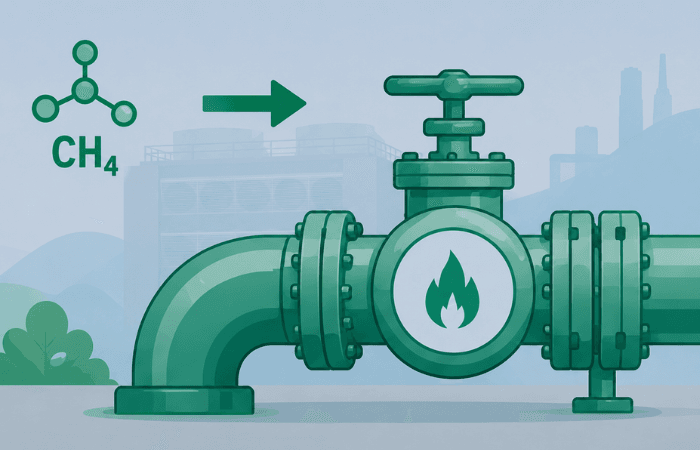
eMethane Made Using Captured CO2 and Green Hydrogen
29 May 2026
By Dr. John Breen
eMethane, or synthetic natural gas (SNG), is methane made from green hydrogen and captured CO₂. In a net-zero fuel route, the hydrogen is produced by water electrolysis using renewable electricity, while the CO₂ can be captured directly from air using Direct Air Capture (DAC).
Direct Air Capture for Sustainable CO2 Feedstock for SNG
DAC is an excellent source of sustainable CO2 as it provides recycled atmospheric carbon rather than carbon taken from fossil reserves. This is strongest where the DAC unit is powered by renewable electricity and waste heat from industrial processes like the hydrogen electrolyser. Solid-sorbent DAC systems typically operate at 80 to 120°C, which makes them more compatible with lower-temperature heat sources than high-temperature liquid DAC routes.
eMethane Production
Synthetic Natural Gas from Hydrogen
The core production step is CO₂ methanation, also known as the Sabatier reaction:
CO₂ + 4H₂ → CH₄ + 2H₂O ΔH° ≈ −165 kJ/mol
This means one mole of CO₂ reacts with four moles of hydrogen to produce one mole of methane and two moles of water. The reaction is exothermic, so heat is released during methane formation. In industrial systems, this is usually carried out over a catalyst, commonly nickel-based, at elevated temperature and pressure.
Why Make Methane Instead of Using Hydrogen Directly?
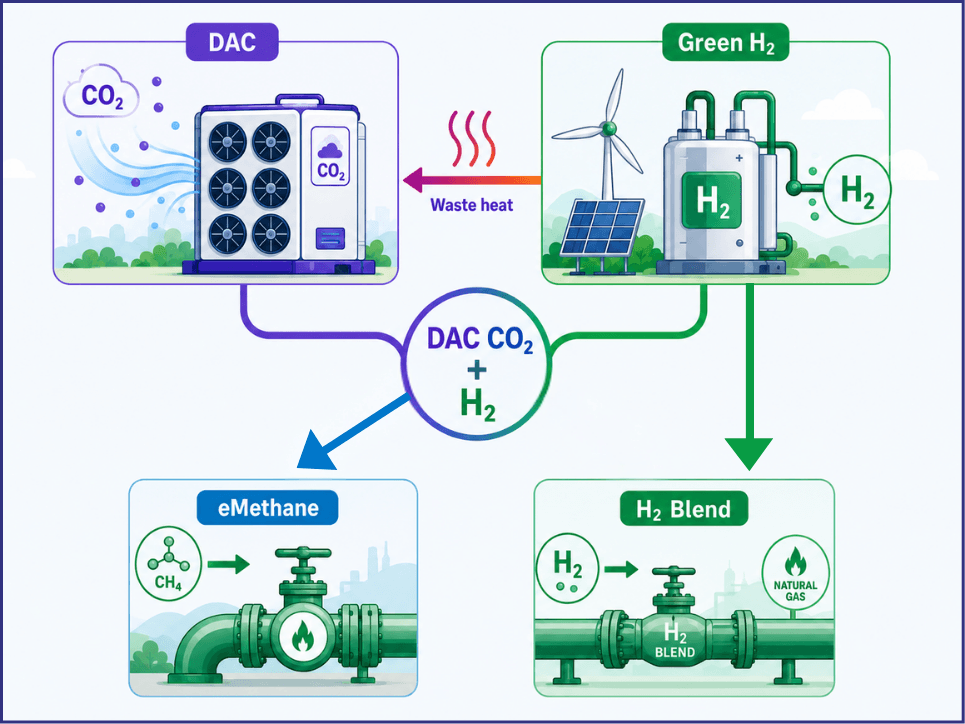
Options: eMethane from CO₂ + H₂ or H₂ Blend into Methane Pipelines
The major argument for eMethane is system compatibility. Methane is already the main energy carrier in natural gas grids, boilers, gas turbines, industrial burners, storage caverns, LNG systems, metering systems and pipelines. Since eMethane is chemically the same as fossil methane, it can often be used as a drop-in gas, subject to gas-quality standards and certification.
Hydrogen has higher energy per kilogram than methane, but it has much lower energy per unit volume. Therefore, blending hydrogen into natural gas reduces the energy content of a given volume of gas and can increase flow, compression and pressure-drop requirements. Altogether, reduced energy density, increased flow speed, pressure losses, leakage, embrittlement and combustion behaviour are key technical issues.
In practice, many gas networks can only accept limited hydrogen blends without changes to infrastructure or end-use equipment. For example, while Great Britain has supported up to 20% hydrogen by volume in gas distribution networks, a separate UK Government consultation on the high-pressure National Transmission System considered only up to 2% hydrogen by volume, due to concerns around downstream users, safety, equipment performance and required modifications.
The Energy Trade-Off: Hydrogen Efficiency vs Methane Compatibility
From a pure molecule-efficiency view, hydrogen is more efficient because converting it to methane causes a thermodynamic loss.
Before plant losses are included, converting 4 mol of H₂ (hydrogen) into 1 mol of CH₄ (methane) reduces the gross calorific value by about 22%.
Further losses occur through heat rejection, compression, gas clean-up, water handling and part-load operation. However, some losses can be reduced if the heat from methanation is recovered into the process.
Injecting hydrogen into the existing gas grid to blend with methane has one main benefit: it avoids the extra methanation step.
This preserves more of the hydrogen’s original energy. It also avoids the need to source and process CO₂. For low blend levels, this can be a useful early route.
In summary:
Blending hydrogen creates limits and constraints:
- Hydrogen has a lower volumetric energy density than methane, so a higher volumetric flow is needed to deliver the same energy.
- Some pipelines, seals, valves, compressors, storage systems and meters may require assessment or upgrade.
- Some industrial and domestic burners may need checks for flame speed, Wobbe index, NOx behaviour and safety.
- Blending provides only limited decarbonisation at modest volume percentages because hydrogen contributes less energy per unit volume than methane.
By contrast, eMethane carries a production penalty, but can be injected ‘as is’ in the downstream gas system. This avoids many of the practical issues caused by hydrogen blending. For a gas network owner, industrial heat user or power plant operator, that compatibility can be worth more than the lost conversion efficiency. Therefore, the trade-off is:
Physics efficiency favours hydrogen.
System compatibility favours methane.
In many short- to medium-term gas systems, compatibility may win because existing infrastructure, appliances, storage systems and industrial burners have long asset lives.
Costs of Converting Hydrogen to Methane
The added cost is not just the reactor. A full eMethane system may include CO₂ conditioning, H₂ compression, methanation reactor, heat management, water removal, gas polishing, metering and grid-injection equipment.
However, the largest CAPEX in most power-to-methane systems is still the hydrogen path, mainly the electrolyser and electricity supply. A techno-economic study found that the hydrogen path dominated investment cost, accounting for 69% to 86% of total cost in PEM-based cases, depending on scale.
For the methanation element itself, published values vary by scale, reactor type and whether the electrolyser is included. A power-to-gas review (ScienceDirect) found that electrolysis and methanation costs have fallen and projected that both could decline to below €500 per kilowatt electric power input by 2050, where methanation cost is referenced to electrolyser electrical input and does not include the electrolyser itself.
OPEX is dominated by the cost of electricity when the full hydrogen-to-methane chain is included.
Is the extra cost worth it?
The extra methanation cost is most likely justified where the final energy system already depends on methane and where replacing infrastructure would be expensive or slow. This includes gas-grid injection, long-duration storage as well as industrial heat, gas turbines, back-up generation and existing pipeline systems.
It is less likely to be justified where hydrogen can be used directly in a dedicated hydrogen user, such as ammonia production, refining, some steel processes or a purpose-built hydrogen pipeline. In those cases, converting hydrogen to methane adds cost, loses energy and requires CO₂ supply.
Therefore, the decision depends on the use case. If the aim is maximum energy efficiency, hydrogen is preferred. If the aim is to deliver low-carbon gas through existing methane assets, eMethane can be the more practical route.
Conclusion
Although eMethane is not the most energy-efficient use of renewable hydrogen (some energy is lost when hydrogen and CO₂ are converted into methane) it does solve a different problem: it allows renewable hydrogen and captured CO₂ to be converted into a gas that fits existing methane infrastructure. Hydrogen blending is simpler in chemistry but limited by gas-grid tolerance, safety and lower volumetric energy density. The strongest case for eMethane is therefore where DAC CO₂, renewable hydrogen, waste heat and existing gas infrastructure can be combined.
For other options of CO₂ + hydrogen, see: eMethane vs eMethanol vs eSAF
For more:
- What is eFuel
- Sustainable Aviation Fuel
- Methanol-to-Jet Fuel
- What is eMethanol?
- The Path to Sustainable Aviation White Paper by Prof. Don MacElroy
- CORSIA vs EU ETS: Why the Difference is Relevant for Direct Air Capture (DAC) and eSAF
- Lift Off for NEG8 Carbon in Sustainable Aviation Fuel