
Green Energy Parks Should Include Direct Air Capture for Clean Growth in Ireland
7 May 2026
Direct Air Capture (DAC) should sit beside renewable energy and heavy emitters as part of Ireland’s next phase of industrial development with energy security.
The vision of Green Energy Parks with Direct Air Capture included gives Ireland a way to bring large energy users, such as data centres and manufacturing, closer to renewable power while also creating routes for CO₂ removal for decarbonisation and utilisation, waste-heat use and benefits to the local community.
What are Green Energy Parks and LEAP?
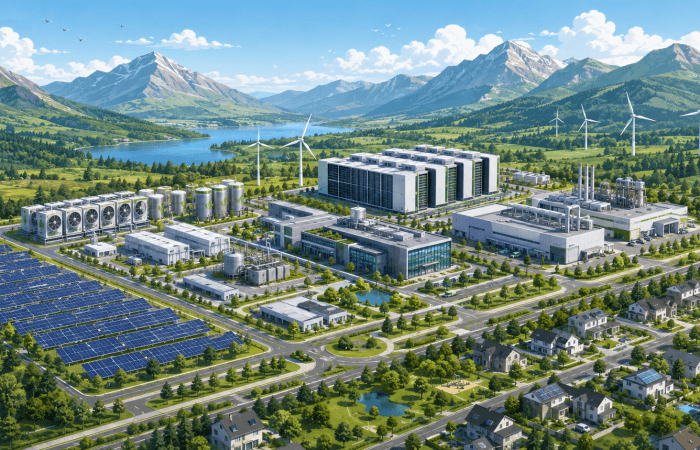
Green Energy Parks are planned industrial and energy zones in Ireland where large energy users are co-located with renewable energy generation, storage and supporting energy infrastructure. In essence, the power demand and power supply are located together.
This forms part of the Irish Government’s Large Energy User Action Plan (LEAP). Offshore wind is the main energy focus, although solar PV is also in the mix.
The Government describes LEAP as a strategy to support future investment in energy-intensive sectors while unlocking Ireland’s renewable energy opportunity, that is, LEAP makes renewable energy projects more bankable, while improving grid use and regional development.
In practice, this means a Green Energy Park can bring together data centres, wind generation, solar PV, battery storage, dispatchable back-up, grid-support assets, green hydrogen, eFuels, manufacturing and other high-value industries, all aligned from the start.
The Economic Benefits of Green Energy Parks
In the Government-commissioned report, An Economic Assessment of Green Energy Park Concepts, a hypothetical fully developed Green Energy Park is modelled. It consists of:
- A 1 GW fixed offshore wind farm
- A 150 MW onshore wind farm
- A 150 MW solar farm
- Offshore and onshore substations
- Battery storage
- A 500 MW data centre
- A 20 MW green hydrogen facility
- A 100 MW pharmaceutical manufacturing facility
In that model, the park could:
- Add up to €3.069 billion in annual gross value
- Support 3,400 full-time equivalent jobs
- Add €1.19 billion in gross value added (GVA) during development and construction
- Support 10,661 construction and development jobs
- Mitigate up to 2.108 million tonnes of CO₂ equivalent.
Why Ireland is Moving towards this Model
Ireland has a strong renewable energy opportunity, but it also has a planning and grid challenge. Large energy users need secure power while renewable projects need revenue generating demand. Additionally, local communities need jobs, housing, amenities and fair benefits. Green Energy Parks are designed to connect these needs in one planned model and LEAP sets out this approach for very large energy users, including hyperscale data centres, semiconductor facilities and biopharma sites.
Of particular interest is Bord na Móna’s landbank in the Midlands and west that could become a major base for energy parks that combine wind farms, data centres and manufacturing facilities. This would add a new role for former peatlands by linking renewable energy with high-value industry.
Furthermore, there is the potential for Ireland to become an energy exporter if wind power is developed properly as Ireland is a perfect location for effective wind power generation because of its unique geographical and atmospheric conditions. Also, it sits in one of the most productive wind corridors on Earth.
Data Centres in Context
We cannot get around the fact that data centres use vast amounts of electricity with Irish data centre electricity use accounting for 22% of metered electricity consumption in 2024, up from 5% in 2015.
However, the issue is not only the amount of energy used but how that demand is supplied, where it is located and what wider value is created from it. Data centres play an important role in the Irish economy and they account for about 21,000 direct employees within an ICT sector ecosystem of more than 180,000 employees.
For Ireland, the question is how data centres can be planned so that they support renewable power, reduce grid pressure, enable CO₂ removal and return value to communities.
Where Direct Air Capture Fits in Green Energy Parks
Direct Air Capture can strengthen the Green Energy Park model by creating a link between renewable energy, data centre cooling, decarbonisation and CO₂ utilisation. (See: How does Direct Air Capture Work?)
DAC has a good fit with data centres because data centres produce suitable low-grade waste heat to power the DAC process. Recent European Commission reporting reviewed the use of low-grade data centre waste heat, typically 30-70°C, for district heating, cooling, water treatment and DAC. This is encouraging in light of the EU mandate, which stems from the Energy Directive (EU) 2023/1791 (Article 26), for data centres to use their waste heat.
For a DAC company, this is a major opportunity. Data centres need cooling and have heat that is often rejected while DAC needs energy and can make use of low-grade heat, depending on the technology. In the case of NEG8 Carbon, DAC can be configured for CO₂ capture, data centre cooling and water harvesting. (See: Sustainable Data Centres with Direct Air Capture)
Arklow: Ireland’s first Green Energy Park
Echelon Data Centres has announced that its DUB20 campus in Arklow, Co Wicklow, will become Ireland’s first Green Energy Park. The project is being developed under the LEAP model and is located at the former Irish Fertilisers Industries site at Avoca River Business Park.
The Arklow project shows how the model can work. Echelon states that DUB20 will include a joint 220 kV substation with SSE Renewables, enabling access to up to 800 MW of offshore wind from Arklow Bank Wind Park Phase 2. The site also includes planned solar PV generation, battery energy storage systems and two onsite energy centres, one of which can export power back to the national grid when needed.
This changes the role of a data centre campus. Instead of being treated only as a large power load, it can become part of a broader energy system.
Kilmeaden: Linking Digital Infrastructure with Community Benefits
The planned Kilmeaden Technology Park in Waterford is another potential Green Energy Park. It will be developed and operated by Echelon Data Centres and is described as a multi-billion-euro investment that will include a data centre and energy campus, future offshore wind landing potential from the Waterford coastline, construction jobs and permanent roles.
Its community model is also worth noting. The project plans to use waste heat from the data centres for cost-effective district heating, supplying homes and the village.
This is where Green Energy Parks move beyond energy supply to being facilitators of affordable and environmentally friendly communities.
The Green Industrial Vision for Ireland
Ireland has the chance to turn large energy demand into an industrial asset. Green Energy Parks can help align offshore wind, solar, battery storage, data centres, manufacturing, eFuels, DAC and community heating in one model. For Ireland, the opportunity is being presented to build energy parks that do more than power industry.
For more:
- Sustainable Data Centres with Direct Air Capture
- AI for Good, Data Centre Growth and the Carbon Removal Link
- Data Centre Cooling Solutions with Direct Air Capture
- The Future of Data Centres: What LCAW Revealed
- The Data Centre Industry has a Problem. Actually, it has Three
- What Waste Heat Reuse Does for Data Centre Approvals
- What are PUE and WUE in Data Centres?
- Direct Air Capture Using Waste Heat