

Sustainability in the Chemicals Industry
8 April 2026
By: Dr David Mulrooney and Jeannie De Vynck
From Capture to Conversion: Integrating Direct Air Capture into Chemicals Manufacturing
Direct Air Capture (DAC) can support the chemicals industry in decarbonising by supplying captured CO₂ as a sustainable feedstock for chemical production, while also mitigating carbon emissions, as the chemicals sector works toward net-zero and compliance with climate regulations.
Why the Chemicals Industry is Hard to Decarbonise
This sector struggles to decarbonise as fossil resources are used in two ways in its processes. They are burned for heat and power, but they are also used as feedstock to provide the carbon atoms that end up inside chemical products. That makes the challenge different from sectors where the main issue is fuel combustion alone.
Critically, the IEA notes that the chemical sector is one of the three industries that contribute over half of industrial energy use and around 70% of direct carbon dioxide (CO2) emissions from industry [iea.org]. The other two are steel and cement. It’s also important to note that about half of its energy input is used as feedstock rather than simply as an energy source.
A second difficulty is that many basic chemicals are made in large plants that rely on high temperatures, hydrogen, steam cracking, reforming and closely integrated process chains. Once such sites are built, they tend to operate for decades, slowing change and raising the cost of replacing fossil routes with electrified or circular-carbon routes.
A third issue is that not all emissions are easy to eliminate through electrification. Even if renewable electricity is added and furnaces are electrified, the question of where the carbon in the product comes from still remains, meaning that a non-fossil carbon source is needed.
Direct Air Capture can Help the Chemicals Industry’s Sustainability Efforts
(See: How does Direct Air Capture Work?)
DAC can support chemical sector decarbonisation in two ways.
Firstly, DAC mitigates industrial carbon emissions by capturing atmospheric CO2. This does not replace emissions reduction activities, but it helps remove the residual emissions that remain after process changes, fuel switching and efficiency measures have already been applied. The EU has now created a voluntary certification framework for permanent carbon removals, and DAC with carbon storage (DACCS) is one of the methodologies included.
Secondly, DAC provides a non-fossil carbon feedstock for chemicals manufacture. This does not automatically create a net-negative product, because the CO2 may be released later in the product life cycle, but it can still reduce reliance on new fossil feedstock and help support decarbonised chemical value chains.
Furthermore, the DAC process can make use of industrial waste heat which lowers the energy usage and therefore the cost.
DAC also has a practical advantage. Unlike point-source capture, it is not tied to the emitting source. It can be placed where renewable power, low-carbon heat, CO2 transport and storage, or chemical demand are best aligned. That flexibility fits well with the EU’s industrial carbon management agenda, which is aimed at building a single market for CO2 transport, use and storage.
DAC as a Source of CO2 Feedstock for the Chemicals Industry
For the chemical industry, the great value of DAC is that it can supply carbon without extracting new fossil carbon from the ground, which aligns with the wider move to alternative carbon feedstocks. In practice, DAC-derived CO2 is most relevant where CO2 is already used directly, or where it can be hydrogenated or otherwise converted into a saleable intermediate.
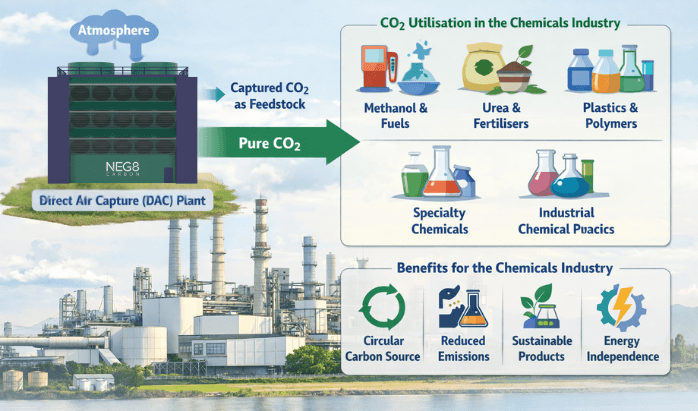
Examples of Chemicals that use CO2 as a Feedstock
Note: the table below shows the minimum amount of CO2 needed, expressed as tonnes of CO2 needed per tonne of product if the chemistry follows the ideal balanced reaction. Plants may consume more because of conversion losses, purge streams, separations and recycle requirements.
* Stoichiometric: the exact, quantitative ratio of reactants and products in a chemical reaction
| Chemical / product | Typical CO₂ use route | Stoichiometric* CO₂ needed | Notes |
| Methanol | CO₂ + 3H₂ → CH₃OH + H₂O | 1.37 t CO₂ / t methanol | A platform chemical and fuel intermediate; one of the main CO₂ utilisation routes under study and commercial deployment. |
| Formic acid | CO₂ + H₂ → HCOOH | 0.96 t CO₂ / t formic acid | Used in chemicals, leather, textiles and as a possible hydrogen carrier. |
| Urea | 2NH₃ + CO₂ → (NH₂)₂CO + H₂O | 0.73 t CO₂ / t urea | The largest established industrial use of CO₂ as a chemical feedstock, e.g. in fertilisers, resins and plastics. |
| Propylene carbonate | Propylene oxide + CO₂ → propylene carbonate | 0.43 t CO₂ / t product | A cyclic carbonate used in electrolytes and solvents. |
| Salicylic acid | Kolbe-Schmitt type carboxylation using CO₂ | 0.32 t CO₂ / t product | A fine chemical intermediate used in pharmaceuticals and preservatives. |
| Sodium bicarbonate | Na₂CO₃ + CO₂ + H₂O → 2NaHCO₃ | 0.26 t CO₂ / t sodium bicarbonate | A mature carbonation route in inorganic chemicals. |
Complementary Approaches Towards a Net-Zero Chemical Industry
DAC is seen as one part of a broader decarbonisation strategy, not as a stand-alone solution. In practice, the chemical sector is pursuing several complementary routes to decarbonise.
Energy efficiency and heat recovery cut fuel use and usually improve economics. These measures do not solve the feedstock problem, but they reduce the scale of the remaining challenge.
Electrification is another approach. Where process heat can be shifted from fossil combustion to electricity, direct plant emissions fall provided the power supply is low carbon.
Renewable and low-carbon hydrogen is central for ammonia, methanol and many hydrogenation routes. In DAC-to-chemicals pathways, hydrogen cost and availability matter as much as DAC cost.
EU Regulations and Policies Relevant to Chemical Industry Emissions
(See: EU Climate Regulations Explained)
| EU policy / regulation | Relevance to chemicals industry and DAC |
| EU Emissions Trading System | For much of the chemicals industry, the EU ETS remains the main carbon-pricing mechanism. DAC is not yet permitted within the EU ETS, with a decision on its inclusion expected in the 2026 ETS review. |
| Industrial Emissions Directive | This governs permitting and operating conditions for major industrial sites and is aimed at reducing pollution while promoting energy efficiency, circularity and decarbonisation. |
| Carbon Border Adjustment Mechanism | CBAM applies especially for parts of the value chain linked to fertilisers and hydrogen, and more broadly because it changes the trade context for carbon-intensive materials entering the EU. |
| Corporate Sustainability Reporting | Large companies in scope of the CSRD must report sustainability information using the ESRS framework. For chemicals companies, that means stronger disclosure on climate risks, transition plans, emissions and governance. |
| Net-Zero Industry Act and EU Carbon Management Policy | These policies support the build-out of CO2 transport and storage infrastructure. The NZIA sets a target of at least 50 million tonnes per year of EU CO2 injection capacity by 2030. DAC with storage only works at scale where durable storage exists. |
| Carbon Removals Certification Framework (CRCF) | Where a chemical company is considering DAC with permanent storage, the CRCF applies. The EU’s framework is voluntary, but it gives common rules for certifying permanent removals, including DACCS. The CRCF separates genuine removals from weaker claims and provides a clearer basis for investment and procurement decisions. |
Conclusion: Aiming for Net-Zero Chemicals
Efficiency, electrification and process redesign will all be needed to decarbonise the chemicals industry, but DAC has a distinct role. It can supply atmospheric CO2 as a feedstock, while also providing certified permanent carbon removals. For an EU chemicals sector dealing with increased pressure to remove fossil carbon from both energy and feedstocks, DAC should be viewed as a strategic enabling technology.
For more:
- Industrial Decarbonisation
- Sustainable Plastics Manufacturing
- Decarbonising Steel
- Decarbonising Cement and Concrete
Interested in NEG8 Carbon’s CO2 capture technology?
Sources:
- https://www.iea.org/energy-system/industry/chemicals
- https://www.iea.org/energy-system/carbon-capture-utilisation-and-storage/direct-air-capture
- https://www.iea.org/data-and-statistics/charts/co2-capture-by-direct-air-capture-planned-projects-and-in-the-net-zero-emissions-by-2050-scenario-2020-2030
- https://www.iea.org/commentaries/ccus-projects-around-the-world-are-reaching-new-milestones
- https://www.iea.org/reports/about-ccus
- https://www.iea.org/reports/ccus-in-clean-energy-transitions/ccus-in-the-transition-to-net-zero-emissions
- https://www.iea.org/reports/putting-co2-to-use
- https://commission.europa.eu/topics/competitiveness/clean-industrial-deal_en
- https://climate.ec.europa.eu/eu-action/industrial-carbon-management/about-industrial-carbon-management_en
- https://climate.ec.europa.eu/eu-action/carbon-markets/eu-emissions-trading-system-eu-ets_en
- https://environment.ec.europa.eu/news/revised-industrial-emissions-directive-comes-effect-2024-08-02_en
- https://eur-lex.europa.eu/legal-content/EN/TXT/PDF/?uri=OJ:L_202401785
- https://taxation-customs.ec.europa.eu/carbon-border-adjustment-mechanism_en
- https://finance.ec.europa.eu/financial-markets/company-reporting-and-auditing/company-reporting/corporate-sustainability-reporting_en
- https://enterprise.gov.ie/en/what-we-do/the-business-environment/corporate-sustainability-reporting/
- https://eur-lex.europa.eu/legal-content/EN/TXT/PDF/?uri=OJ:L_202401735
- https://climate.ec.europa.eu/eu-action/carbon-removals-and-carbon-farming_en
- https://climate.ec.europa.eu/news-other-reads/news/eu-sets-worlds-first-voluntary-standard-permanent-carbon-removals-2026-02-03_en
- https://eur-lex.europa.eu/eli/reg/2024/3012/oj/eng
- https://royalsociety.org/-/media/policy/projects/defossilising-chemicals/defossilising-chemical-industry-report.pdf
- https://royalsociety.org/news/2024/05/chemical-industry-must-defossilise-to-reduce-carbon-emissions/
- https://publications.jrc.ec.europa.eu/repository/bitstream/JRC99380/ld1a27629enn.pdf
- https://publications.jrc.ec.europa.eu/repository/bitstream/JRC118310/jrc118310_1.pdf
- https://bureau-industrial-transformation.jrc.ec.europa.eu/reference/production-large-volume-organic-chemicals-0
- https://bureau-industrial-transformation.jrc.ec.europa.eu/reference/large-volume-inorganic-chemicals-ammonia-acids-and-fertilisers
- https://pubchem.ncbi.nlm.nih.gov/compound/Carbon-Dioxide
- https://pubchem.ncbi.nlm.nih.gov/compound/Carbonic-Acid
- https://pubs.rsc.org/en/content/articlehtml/2015/ee/c5ee02591e
- https://publications.ieaghg.org/technicalreports/2021-02%20CO2%20as%20a%20Feedstock%20Comparison%20of%20CCU%20Pathways.pdf