
What is eFuel?
26 January 2026
eFuels are liquid or gaseous fuels produced using electrical energy rather than fossil feedstocks. The fuels are designed to be chemically similar to conventional fossil fuels and can be used in existing engines, turbines, and fuel distribution systems.
Why are they called eFuels?
The term eFuel is used because electricity is the primary energy input used to produce the fuel. The electrical energy should be from renewable sources to gain the decarbonisation benefit.
Related Terms for eFuel
- Power-to-Liquid Fuels
Power-to-liquid fuels are a subset of eFuels where renewable electricity is used to power the carbon capture technologies and hydrogen generation technologies which when combined are used to produce liquid hydrocarbons. These fuels are suitable for applications where high energy density is required, such as aviation and maritime transport. - Electrofuels, Green Fuels and Carbon-neutral Fuels
Electrofuels and green fuels are terms used to describe fuels produced using renewable electricity and feedstocks and these fuels may be described as carbon neutral and net-zero. - Synthetic Fuels
Synthetic fuels are fuels produced by chemical synthesis rather than fossil fuel extraction. eFuels are a specific category of synthetic fuels where electricity is the primary energy input. Their role is focused on enabling emissions reduction in sectors where direct electrification is not feasible at scale, for example, aviation and marine long haul.
How do you Make eFuel?
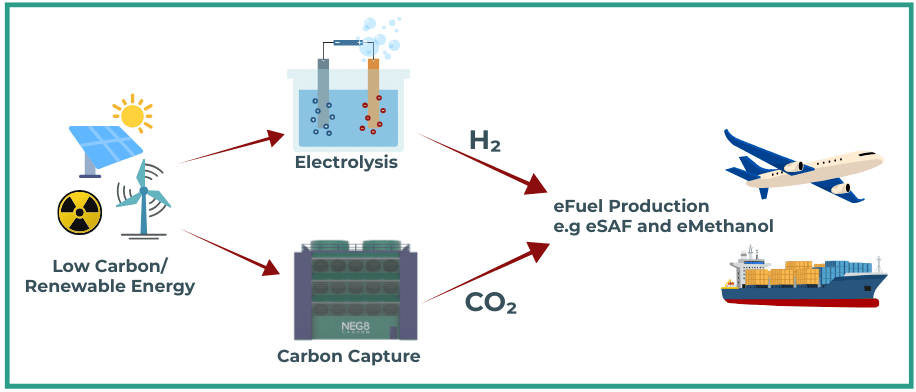
eFuels consist of hydrogen (H2) and carbon dioxide (CO2). For eFuels to be considered sustainable, the hydrogen, which is produced by electrolysis of water, needs to be ‘green hydrogen’. Green hydrogen is when electrolysis is powered by near zero carbon or renewable energy.
Similarly, the CO2 used should be captured from directly from the atmosphere using Direct Air Capture (DAC) or at industrial point sources. When the CO2 and H2 are combined through controlled chemical synthesis, hydrocarbon fuels are produced.
The production of eFuels follows a power-to-liquid or power-to-gas route.
- Electricity is used to split water into hydrogen and oxygen via electrolysis.
- Carbon dioxide is captured from air using DAC or industrial exhaust streams.
- Hydrogen and carbon dioxide are reacted using catalytic processes such as Fischer–Tropsch synthesis or methanol synthesis.
- The resulting fuel is refined to meet application-specific standards.
Role of eFuels in Net-Zero Energy Systems
Using captured CO₂ to make eFuel
eFuels are the sustainable alternatives to conventional fossil fuels and therefore is it important that captured carbon dioxide is used as a carbon source. When carbon dioxide captured from the air (using DAC) or industrial sources is reused in fuel synthesis, a closed carbon cycle is formed. Carbon released during fuel combustion matches the amount previously captured, provided renewable electricity is used.
eFuels support net-zero targets by enabling low-carbon operation of sectors that are difficult to electrify directly. Aviation, shipping, and heavy-duty transport are key examples. When renewable electricity and captured carbon dioxide are used, lifecycle emissions can be significantly reduced.
Decarbonisation can be supported through replacing fossil fuels with eFuels in existing applications. This allows emissions reductions without fleet replacement.
Examples of eFuels
Common examples include:
- eSAF: Sustainable aviation fuel produced synthetically for use in aircraft.
- eMethanol: A synthetic alcohol used as a marine fuel and chemical feedstock.
Applications include:
- Aviation through synthetic aviation fuel blends
- Maritime transport using eMethanol
- Road transport where electrification is limited
- Chemical production as low-carbon feedstocks
- Energy storage and long-distance energy transport
Advantages and Challenges eFuels
Advantages of eFuels include:
- Compatibility with existing engines and infrastructure
- High energy density suitable for long-range transport
- Use of renewable electricity for energy storage
- Reuse of captured carbon dioxide
- Support for net-zero fuel pathways
Challenges of eFuels:
While efficiency and cost remain challenges, eFuels offer a practical pathway for reducing emissions in aviation, shipping, and other hard-to-electrify sectors while supporting net-zero energy systems.
Why Using Crops for Biofuels is Harmful
Using crops such as soy and palm oil for biofuels is environmentally damaging because their cultivation drives deforestation, habitat loss, and biodiversity decline, particularly in tropical regions. It also competes with food production and can lead to higher overall emissions when land use change is taken into account, undermining climate benefits.
On the other hand, eFuels offer an alternative to crop-based biofuels by using captured CO₂ and renewable electricity, avoiding land-use change while providing a scalable, low-carbon fuel option for sectors such as shipping where direct electrification is limited. Furthermore, crops for biofuels are a finite resource whereas using Direct Air Capture is infinitely scalable as a resource for CO₂.
Summary
Sustainable eFuels are electricity-derived synthetic fuels produced from green hydrogen and captured carbon dioxide. They provide a route for renewable electricity to be used in liquid and gaseous fuels. Challenges remain, but with government support, eFuel technology development and scaling can be achieved.
For more:
- Sustainable Aviation Fuel for Greener Skies
- What is eMethanol?
- Lift Off for NEG8 Carbon in Sustainable Aviation Fuel